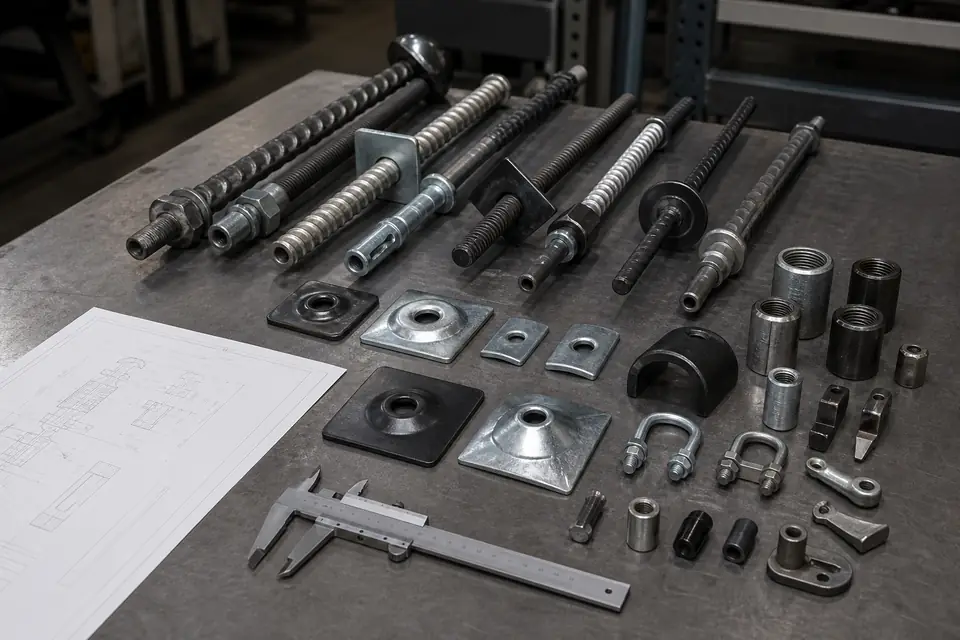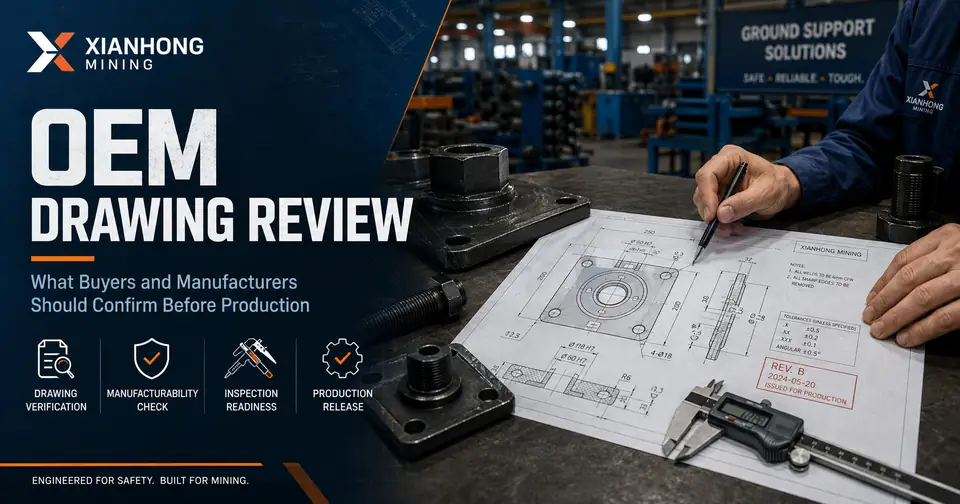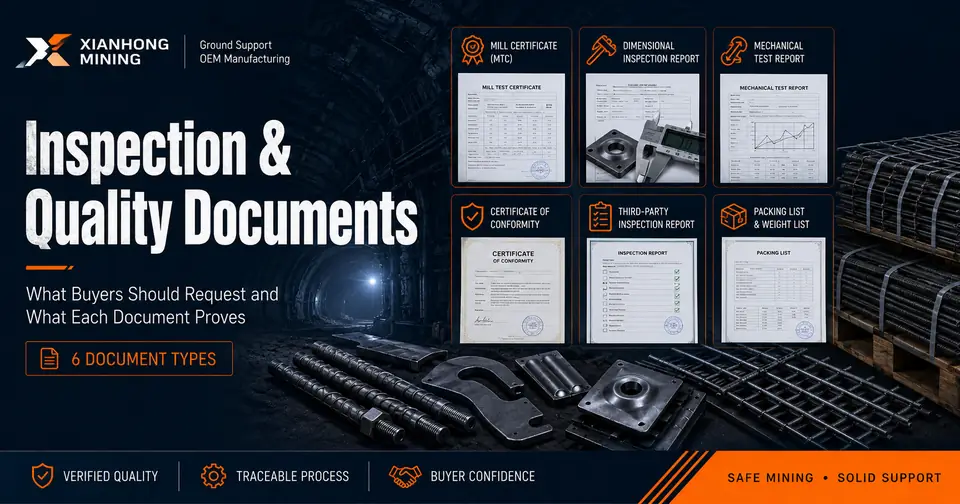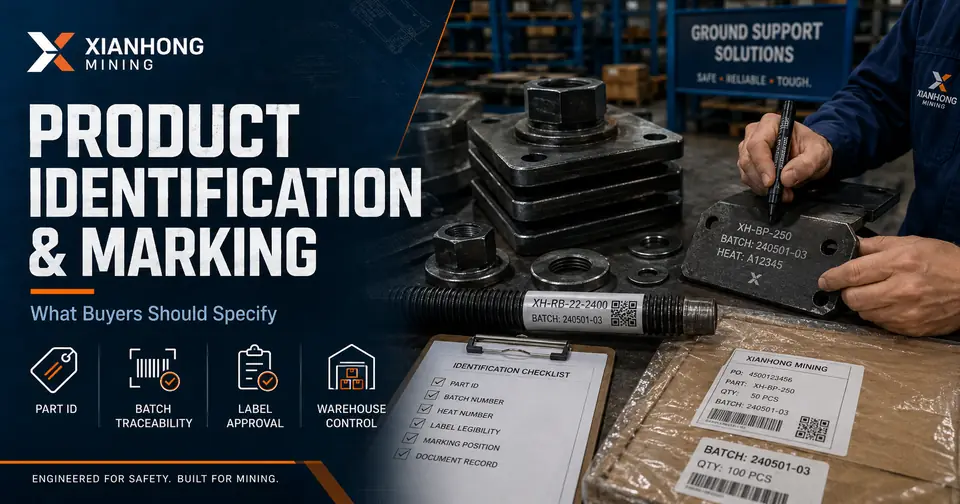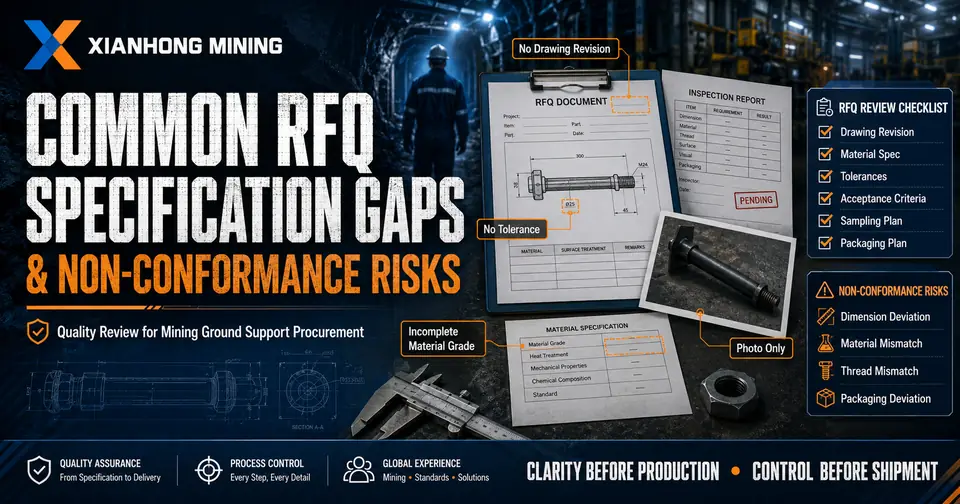

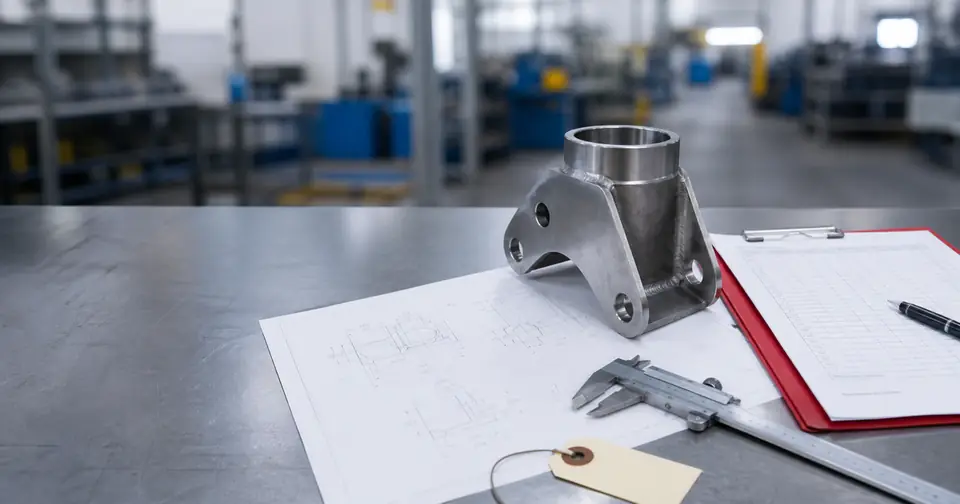
You have an approved drawing or specification. The OEM supplier has produced the first sample or first article. Batch production has not yet been released.
What exactly should be checked, documented and approved before production moves forward?
For mining ground support components, a first article or sample approval can serve as an order-control gate between an approved manufacturing baseline and batch production. It is not a universal requirement for every order, and it is not a substitute for engineering approval of the ground support system. The purpose is narrower: compare the inspected first article with the buyer-approved requirements, record any differences, obtain the required approval, and release production only under the agreed order-control process.
A controlled sequence may look like this:
Approved baseline → First article produced → Inspection evidence → Deviation / clarification if required → Required approval → Production release
The exact sequence, approval authority and evidence package should follow the buyer-approved PO, specification, inspection plan or other order-control documents.
For the earlier baseline-control step, see our OEM Drawing Review Guide. For the evidence package that may support approval, see Mining Ground Support Quality Documents.
Why First Article Approval Exists
The approved, controlled order-document package tells the manufacturer what to make. A drawing may be one part of that package, together with the applicable specification, purchase-order requirements and approved clarifications. The document package does not, by itself, confirm that the first physical unit matches the approved requirements.
A first article review creates a controlled comparison between:
- the approved manufacturing requirement; and
- the actual result recorded on the sample or first article.
The objective is not to prove long-term process capability from one unit. A conforming first article only provides evidence about the characteristics actually inspected on that article under the agreed approval scope. Batch capability, sampling plans and ongoing production controls are separate matters.
What the buyer should confirm here:
- Does this order require a first article or approved sample?
- What document controls that requirement: PO, drawing, project specification, inspection plan or another approved instruction?
- Who has authority to approve the first article?
- What must be completed before batch production can be released?
A repeat order may not require another first article if the buyer-approved baseline and order-control requirements allow the previous approval to remain valid. That decision should be documented rather than assumed.
The key principle is:
Drawing approved ≠ first article automatically accepted.
The approved, controlled order-document package defines the applicable requirements. The first article inspection records whether the characteristics inspected within the agreed scope meet those requirements.
Hypothetical dimensional example
If a specified feature is 12.0 mm ± 0.5 mm, an inspected result of 12.4 mm is within the stated tolerance range and should still be recorded against that requirement.
If another feature is specified as 1.5 mm ± 0.2 mm, an inspected result of 1.2 mm is outside the stated range and requires a documented disposition before that characteristic can be accepted.
These values are illustrative only. Actual acceptance criteria must come from the buyer-approved drawing, specification or other controlled order requirement.
When a Sample or First Article Should Be Defined
A first article requirement should come from the buyer-approved order-control process, not from a universal supplier rule.
Conditions that may lead a buyer to require a first article or renewed sample approval include:
- New drawing or new part — a component is being manufactured for the first time against a new approved requirement.
- New tooling or manufacturing setup — where the buyer-approved control plan treats the change as relevant to approved characteristics.
- New product configuration — geometry, material, finish or another controlled characteristic changes.
- Agreed significant change — both parties agree that a change warrants re-confirmation.
- Buyer-required approval — the buyer's own procedure requires first article approval.
- Repeat order with changed baseline — an earlier approval may no longer represent the current order.
What the buyer should confirm:
- Is first article approval explicitly required for this order?
- What is the trigger?
- Which characteristics are included in the approval scope?
- Does a previous approval remain valid, or is a new approval required?
The important point is not to create a universal trigger list. It is to define the requirement clearly enough that buyer and manufacturer are working to the same order-controlled approval scope.
Confirm the Approval Baseline Before Making the Sample
Before the manufacturer produces the first article, both parties should identify the controlled requirements against which it will be reviewed.
This approval baseline may include:
| Item | What to confirm |
|---|---|
| Drawing number | The buyer-approved drawing applicable to the sample. |
| Drawing revision | The approved revision that controls the characteristics shown on that drawing. |
| Specification reference | Applicable material, coating, thread, dimensional, performance or other requirements referenced by the order. |
| Approved clarification | Any buyer-approved clarification or controlled instruction that explains or completes the applicable requirement for the order. |
| Approved deviation / concession reference | Any authorised disposition that permits a defined difference for the identified order, characteristic and scope without silently changing the original requirement. |
| Material requirement | The required grade, standard or specification, where applicable. |
| Inspection scope | Which characteristics are to be checked and what acceptance criteria apply. |
| Evidence requirement | What records the buyer requires: dimensional results, material evidence, photos, test records or other agreed documentation. |
| Identification / marking | Product, sample, batch or package identification required for traceability, where applicable. |
| Packing requirement | Any packing or identification requirement that forms part of the sample approval scope. |
The exact baseline can vary by product and order.
Drawing review asks whether the manufacturing inputs are sufficiently clear for production planning. First article approval asks a different question:
Does the inspected first article conform to the controlled requirements included in this approval scope?
If the controlling drawing or specification changes after the sample is produced, the buyer should decide—under the agreed change-control process—whether the existing inspection remains usable or whether a new or revised first article is required.
What the First Article Record Should Contain
The first article record should make it possible to compare approved requirements with actual evidence and to record the required disposition.
The structure below is not a mandatory industry template. Buyers should adapt it to the product, order and approval process.
Group 1: Identification
| Field | Purpose |
|---|---|
| Part / product identification | Identifies the component being inspected. |
| PO / RFQ / project reference | Links the record to the order or project-controlled instruction. |
| Drawing number & revision | Identifies the applicable approved drawing. |
| Specification reference | Identifies other controlled requirements applicable to the inspected characteristics. |
| Sample / first article identification | Distinguishes the inspected article from other units where required. |
Group 2: Approved Requirements
| Field | Purpose |
|---|---|
| Characteristic | Identifies the dimension, feature, material requirement, finish or other item being checked. |
| Nominal / specified requirement | Records the approved requirement. |
| Tolerance / acceptance criteria | Records the applicable acceptance limit or pass/fail basis. |
| Requirement source | Links the characteristic to the drawing, specification or other controlled requirement. |
Group 3: Actual Evidence
| Field | Purpose |
|---|---|
| Actual result | Records the measured, observed or documented result. |
| Inspection / evidence reference | Identifies the measurement record, material record, test report, visual record or other agreed evidence. |
| Method / instrument reference | Included when required by the buyer-approved inspection plan or an applicable controlled quality procedure. |
| Supporting photos / records | Included when required by the agreed approval scope. |
| Inspection date | Records when the inspection or review occurred. |
The presence of a field does not mean Xianhong or any supplier automatically has the corresponding test capability. Inspection, testing and documentation scope should be confirmed for the specific quotation and order.
Group 4: Disposition, Approval and Release
| Field | Purpose |
|---|---|
| Inspection result | Records whether the inspected characteristic is conforming, nonconforming or requires clarification against the applicable acceptance criteria. |
| Authorised disposition | Records the approved action for a nonconforming result, such as rework, remake, rejection or an authorised deviation / concession. |
| Deviation / concession reference | Links any accepted difference to its formal approval record. |
| Buyer / authorised approval status | Records the decision of the party authorised by the order-control process. |
| Production release status | Records whether batch production is released, not released or conditionally released under the agreed process. |
| Approval / release reference | Records how the decision was communicated and controlled. |
What the buyer should confirm:
- Can each inspected characteristic be traced to a controlled requirement?
- Are actual results recorded rather than replaced by a generic “passed” statement where measured results are required?
- Are nonconforming results linked to their disposition?
- Is inspection evidence clearly separated from buyer or authorised approval?
- Is approval clearly separated from production release where the order-control process treats them as separate actions?
For a broader explanation of what different inspection and quality records can and cannot prove, see Mining Ground Support Quality Documents.
What Happens When the First Article Does Not Match the Approved Requirement
If the first article does not meet an approved requirement, the important issue is not to hide or silently absorb the difference. The difference should be recorded and resolved under the agreed deviation or change-control process.
A controlled sequence may be:
-
Record the result. Identify the characteristic and the actual result that does not meet the applicable requirement.
-
Confirm the governing requirement. Check the controlled drawing, specification, tolerance, clarification or other order document before deciding the disposition.
-
Determine the disposition under the approved process. Depending on the order, this may include:
- rework or remake to meet the approved requirement;
- technical clarification;
- formal deviation / concession approval by the buyer or another authorised project party.
-
Re-inspect where required. If the part is reworked or remade, the affected characteristics should be re-inspected according to the agreed approval scope.
-
Update the approval and release record. Batch production or related manufacturing activity affected by the difference should not proceed without the documented disposition and any required production release defined by the order-control process.
What must not happen:
- The manufacturer should not unilaterally approve a nonconforming result on behalf of the buyer or design authority.
- A deviation accepted for one order should not automatically be treated as approval for future orders.
- An engineering or project-specific acceptance decision should not be inferred from a manufacturer's manufacturability or inspection review.
The authority to approve a deviation or concession should be defined by the buyer's order-control process. Depending on the project, that authority may be the buyer, an authorised engineer, the mine, or another designated party.
Inspection Result, Buyer Approval and Production Release Are Different Controls
Three actions are often close together in the workflow, but they should not be treated as interchangeable:
| Control action | What it means | Typical owner |
|---|---|---|
| Inspection result | Records whether the inspected characteristics meet the approved acceptance criteria. | Manufacturer, buyer or third party, depending on the agreed inspection process. |
| Buyer / authorised approval | Records acceptance of the first article under the order-control process. | Buyer or another authorised project party. |
| Production release | Authorises batch production to begin. | The party or internal function defined by the order-control process. |
Inspection result ≠ approval ≠ production release.
A conforming inspection record is evidence. It does not automatically authorise production unless the buyer-approved order process explicitly says that it does.
Likewise, buyer approval may be a prerequisite for release without being the release action itself.
Batch production may begin only after the required production release has been documented under the agreed process.
A controlled sequence may therefore be:
Approved baseline
    → First article produced
        → Inspection evidence
            → Deviation / clarification if required
                → Buyer / authorised approval if required
                    → Production release
Before batch production begins, confirm:
- What approval form is required?
- Who is authorised to approve?
- What evidence must be attached or referenced?
- Is buyer approval itself the release, or is a separate production-release action required?
- Has the final release been documented?
This distinction prevents a passed inspection, an informal comment or internal manufacturing readiness from being mistaken for authority to start the production batch.
When a New First Article May Be Required After a Change
A previous first article approval applies only to the baseline and approval scope against which it was made.
Changes that may require a new or revised first article include:
- an approved drawing revision affecting inspected characteristics;
- a material requirement change;
- a geometry or tolerance change;
- a coating or finish change;
- a tooling, fixture, equipment or process change that the buyer-approved control process treats as relevant;
- another buyer-specified change requiring re-approval.
These are examples, not universal mandatory triggers.
What the buyer should confirm:
- What has changed since the previous approval?
- Does the change affect a characteristic included in the earlier first article scope?
- What does the buyer-approved change-control process require?
- Has the decision to retain, revise or repeat the first article approval been documented?
Do not assume that every process change automatically invalidates an approval, and do not assume that an old approval automatically remains valid.
RFQ Checklist for Sample / First Article Approval
When a buyer wants first article or sample approval included in an RFQ or purchase order, the following fields can make the requirement clearer:
| RFQ field | What to specify |
|---|---|
| Drawing / specification number and revision | The buyer-approved manufacturing baseline. |
| Sample / first article quantity | Number of units to be produced for the agreed approval scope. |
| Characteristics to be checked | Dimensions, features, material, finish, marking or other buyer-controlled requirements to be verified. |
| Acceptance criteria | Tolerances, specifications or pass/fail criteria tied to controlled requirements. |
| Inspection / evidence requirement | Dimensional records, material evidence, photos, test reports or other required documentation. |
| Deviation handling | Who reviews a mismatch, who can approve a concession and what record is required. |
| Approval authority | Buyer, engineer or other authorised project party defined by the order. |
| Approval method | Signature, email, portal approval or other controlled method. |
| Production release condition | What must be complete before batch production starts. |
| Re-approval trigger | Buyer-defined conditions under which a new or revised first article is required. |
These fields are not a fixed universal template. They are procurement inputs that should be adapted to the buyer's order-control process and the specific product.
Download the First Article Approval Checklist
Download the First Article Approval Checklist for OEM Mining Ground Support Components (PDF)
Use the checklist to record the controlled baseline, inspected characteristics, evidence references, authorised disposition and required production release for the specific order. The checklist does not replace buyer or engineer approval of product selection, ground-support design or project-specific suitability.
Responsibility Boundary
First article review does not transfer ground-support engineering responsibility to the manufacturer.
For an OEM order, the manufacturer may:
- review the buyer-approved drawing and specification for manufacturability;
- produce the agreed sample or first article;
- inspect characteristics within the quotation- and order-confirmed scope;
- provide the agreed inspection and traceability records;
- identify apparent nonconformities or documentary conflicts;
- request clarification before production release.
The manufacturer does not, by performing a first article review:
- approve the mine's ground-support design;
- select the correct support system for geological conditions;
- approve project-specific load requirements;
- determine installation parameters;
- confirm site suitability;
- accept a deviation on behalf of the buyer, engineer or other design authority.
Final product selection, support-system design, project-specific engineering approval, installation requirements and site suitability remain with the buyer and the qualified project personnel responsible for the application.
Define Your Sample and First Article Requirements
If you are preparing an OEM mining ground support order, send the buyer-approved inputs that control the sample or first article review:
- current drawing / specification and revision;
- order quantity;
- requested sample or first article scope;
- characteristics and acceptance criteria to be checked;
- required inspection / evidence package;
- deviation and approval process;
- production release condition.
Xianhong Mining can review the requirements for manufacturability and confirm the inspection and documentation scope that can be supported for the specific quotation and approved order. This review does not replace buyer or engineer approval of product selection, ground-support design or project-specific suitability.
Learn more about our OEM Manufacturing approach, or start an OEM RFQ.