
PART OF · OEM Mining Ground Support Procurement
Xianhong Mining can review identification and marking requirements for manufacturability, legibility, traceability logic, and production feasibility. Buyers remain responsible for confirming destination-country marking rules, certification-mark authorization, customer-brand requirements, project-specific identification, and any legal or contractual labeling obligations.
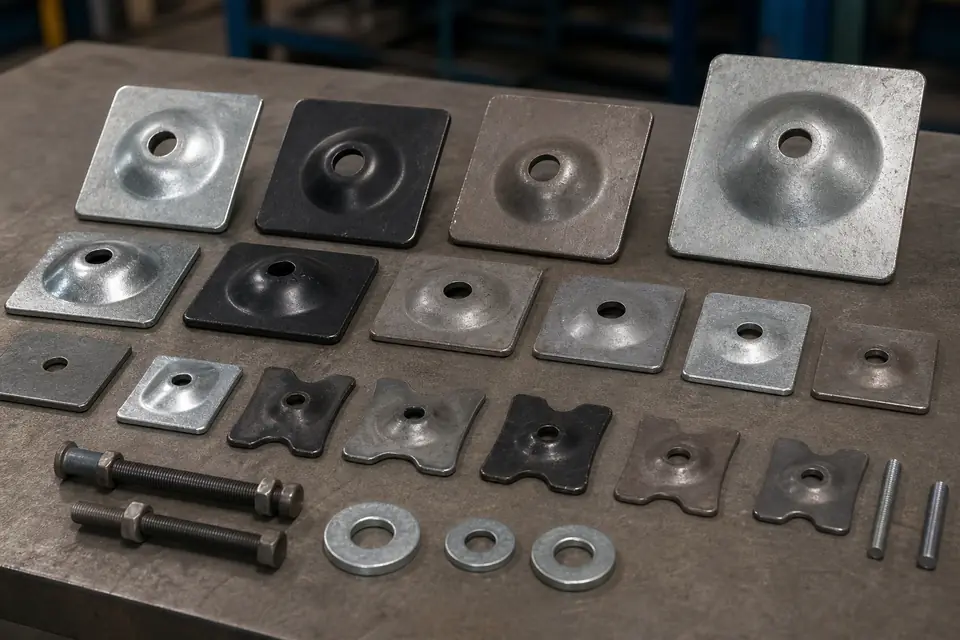
A shipment of bearing plates arrives at the buyer's warehouse. Two purchase orders are involved. The plates look identical from the outside, but they have different hole diameters and come from different material batches. The outer packaging shows only a generic product name. No part number or batch identifier appears on the individual pieces. When the warehouse opens the bundles, the staff cannot determine which plates belong to which order, which material batch, or which inspection report.
The result is not merely a missing label. It is a chain of failures: mixed inventory, inspection records that cannot be matched to physical products, the wrong parts issued to downstream assembly, resale, or installation, and no reliable way to isolate a suspect batch if a defect is later reported.
Marking is not decoration. It is the physical link between the product, the order, and the quality record.
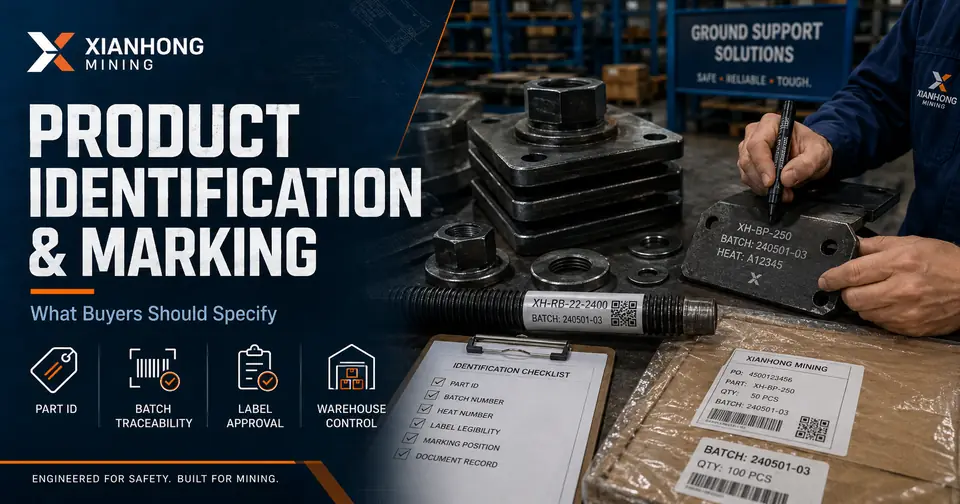
This guide explains how buyers should define the identification level, marking content, method, location, durability, traceability links, and approval process before quotation confirmation or production release.
1. Why Product Identification Matters
Product identification affects every stage after manufacturing. At receiving and during storage, warehouse staff must confirm that delivered products match the order and segregate different part numbers, batches, and orders without confusion. During inspection, QA personnel must connect a physical product to its inspection report, material certificate, and approved drawing revision. During installation and after-sales handling, field crews must confirm they are using the correct component, and if a defect is reported, the buyer must be able to identify and isolate the affected batch, order, and production lot.
Without reliable identification, none of these steps can be performed with confidence. A product that cannot be reliably identified cannot be reliably traced. And a product that cannot be traced is more difficult to recall, isolate, or defend in a quality dispute.
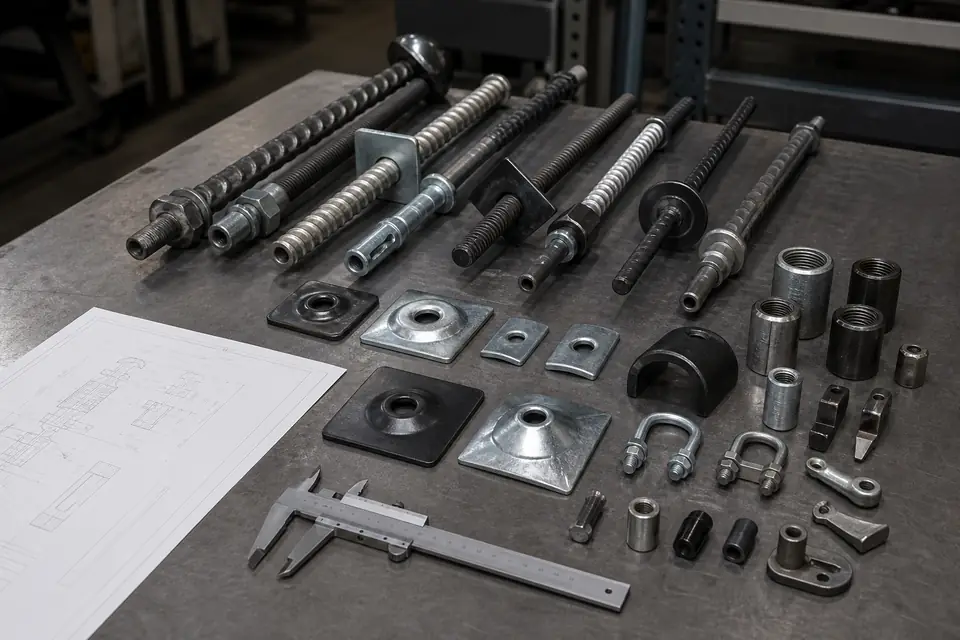
For OEM mining ground support components, the risk is amplified by the fact that many products look similar but differ in critical dimensions, material grade, or surface treatment. Two bearing plates may share the same outline but have different hole diameters. Two rock bolt bars may share the same diameter but have different thread specifications. Visual inspection alone may not distinguish them. Controlled identification provides the reliable link needed after bundles are opened or products are separated.
This is why identification requirements must be defined before production, not decided after the goods arrive.
2. Identification Levels: Part, Bundle, Pallet and Shipment
Product identification is not a single decision. It applies at four levels, and each level serves a different purpose.
Individual Part
Single-piece marking is appropriate for high-value components, parts that are visually similar but differ in critical dimensions, products requiring full traceability, and any item where the buyer has specified a serial number. Typical content includes part number, size, batch number, and manufacturer identification. Not every component needs part-level marking — but when it does, the requirement must be stated explicitly.
Bundle or Package
When individual marking is not practical, identification moves to the bundle level. Bundle-level marking covers groups of identical parts packed together — nuts, washers, small plates, or other high-volume items where individual marking is impractical. The bundle label should carry the product name, part number, quantity, batch number, purchase order number, and gross or net weight where applicable. This is the most common identification level for mining ground support fasteners.
Pallet or Crate
Pallet-level identification supports warehouse handling, forklift movement, destination allocation, and packing list verification. The pallet or crate should display a unique package number, contents summary, quantity, weight, and destination code. This level connects physical goods to the packing list and the shipment documentation.
Shipment or Container
Shipment-level identification includes shipment reference, container number, total package count, and destination. This level is primarily for logistics and customs and overlaps with the Export Packing Guide. This article focuses on the first three levels — part, bundle, and pallet — where product identification, rather than transport logistics, is the primary concern.
3. What Information Should Product Marking Include?
Product marking content falls into five categories. Not every product needs all five, but the buyer should confirm which categories apply and what each field must contain.
Product Identity
This category identifies what the product is: product name, part number, drawing number, size or model, and customer item code if applicable. Part number and drawing number help link the physical product to the approved specification and revision.
Order Identity
This category links the product to a commercial transaction: purchase order number, contract number, project name, and destination or warehouse code. Order identity ensures that products from different orders are not mixed during storage or shipment.
Batch and Traceability Identity
This category enables traceability: batch number, lot number, heat number, production date, inspection lot, and serial number if required. A critical distinction applies here: a heat number identifies a melt of raw material, not a finished-product batch. Depending on the production route, one heat may feed multiple finished-product batches, while one finished-product batch may include material from more than one heat. The buyer and manufacturer must therefore define and record the mapping between material traceability and product traceability; the two identifiers are not automatically interchangeable.
Quantity and Handling Information
This category supports warehouse operations: quantity, net weight, gross weight, package number, pallet number, and handling direction where necessary. This information appears primarily on bundle and pallet labels rather than on individual parts.
Compliance and Customer Marking
This category covers regulatory and brand requirements — manufacturer identification, customer logo, country of origin, certification marks, inspection status, and project-specific marks. These identifiers depend on applicable regulations, certification authorization, and buyer-confirmed requirements. They must not be applied by the manufacturer based on assumption.
4. Permanent, Semi-Permanent and Temporary Identification
The choice between marking methods is not only a question of technology. It is a question of risk: what happens if the marking is lost, illegible, or applied to the wrong surface?
Permanent Identification
Permanent methods include stamping, laser marking, dot peen, cast or forged marks, and embossed marking. When correctly selected and applied, these methods can remain legible after unpacking, transport handling, and long-term storage. They are suitable where single-part traceability or identification after unpacking is required.
Permanent marking also carries process risks. Mechanical marking may damage a surface, disrupt a coating, or be unsuitable on threaded, bearing, highly stressed, or dimensionally controlled areas. Excessive depth can affect local geometry, while small parts may not provide enough space for the required content.
The marking method, location, character size, and any depth limit should therefore be included in the buyer-approved specification before production.
Semi-Permanent Identification
Semi-permanent methods include paint stencil, durable ink, paint pen, and adhesive industrial labels. These methods are suitable for batch-level identification on parts where surface damage is not acceptable, and for components that need to be identified during storage and installation but not necessarily after installation.
Temporary Identification
Temporary methods include paper tags, removable labels, bundle tags, and pallet cards. These are suitable for transport and warehouse identification, but they may be lost or damaged after unpacking. If identification must survive beyond the warehouse stage, temporary marking alone is not sufficient.
| Requirement | Recommended Method |
|---|---|
| Single-part long-term traceability | Laser, dot peen, or stamping |
| Surface cannot be damaged | Adhesive label, tag, or low-impact marking |
| High-volume small parts | Bundle-level or batch-level marking |
| Must remain legible after galvanizing | Buyer-approved method validated for the specified galvanized surface |
5. Marking Method, Location, Size and Durability
“Mark each product with the part number” is not a complete production requirement. The buyer should also confirm:
- Method: stamping, laser, dot peen, paint, adhesive label, or tag.
- Location: the permitted face or surface, including restrictions on threads, bearing areas, and coated surfaces.
- Character size and contrast: the minimum readable size and required visibility.
- Depth: for mechanical methods, the buyer-approved limit that will not interfere with dimensional, surface, or functional requirements.
- Orientation: the required reading direction, where relevant.
- Durability: whether the mark must remain legible through coating, transport, storage, installation, water, oil, abrasion, or other agreed exposure.
- Post-installation visibility: whether field personnel must still be able to read the mark after installation.
A complete requirement might read:
Apply the part number and batch number on the non-bearing face, minimum character height 5 mm, using the approved method validated to remain legible after the specified coating and normal transport handling.
The exact values and validation method depend on the product, coating, process, and buyer-approved specification.
6. Linking Marking to Drawings and Quality Records
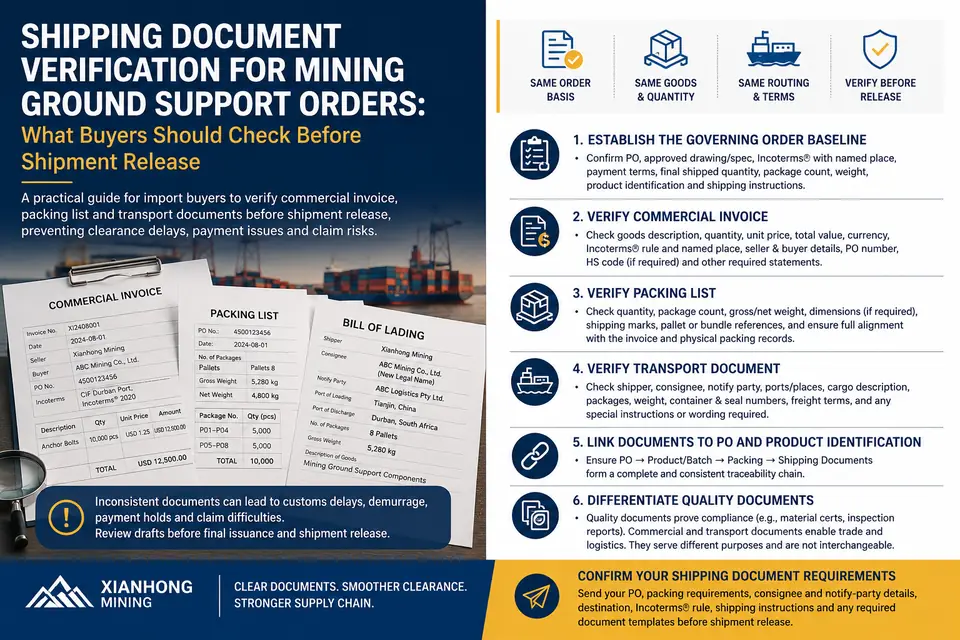
Once product, batch, bundle, and pallet references have been established, the same identifiers should remain consistent in the packing and shipment records. See the Shipping Document Verification Guide for how buyers can verify that chain before and after shipment release.
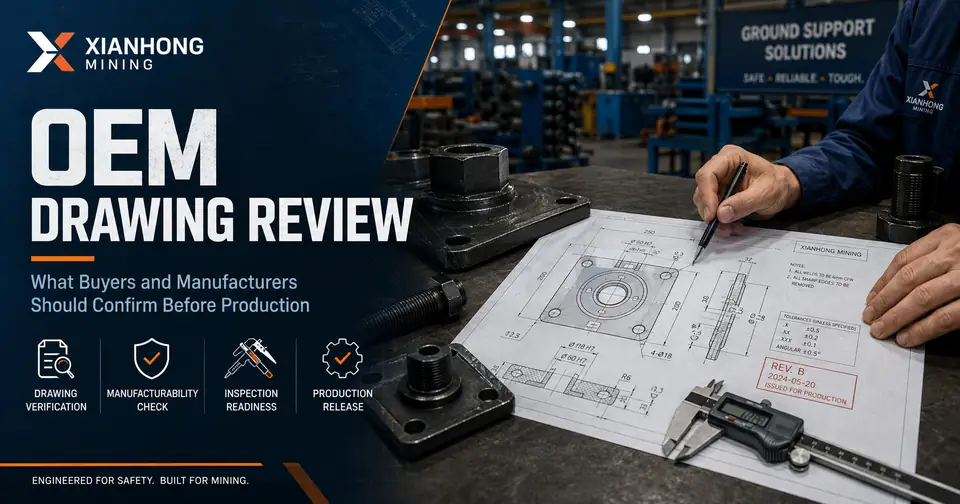
Marking should be controlled together with the approved drawing and specification baseline described in the OEM Drawing Review Guide. The records used to prove conformity are explained in the Mining Ground Support Quality Documents Guide.
A practical traceability chain is:
Product or Package Mark → Batch Number → Inspection Report → Material Record → Purchase Order → Approved Drawing Revision
The chain should allow an authorized person to move from the marked product or package to the product identity, production batch, applicable drawing revision, relevant material and inspection records, packing list, and purchase order.
The required depth varies. A high-value rock bolt bar may require finished-product-to-heat traceability. A bearing plate may require batch-level linkage to inspection and material records. Standard washers may only require package-level batch identification linked to an inspection report.
The marking system must support the agreed traceability depth. If batch-level traceability is required, the approved part or package mark must map to the relevant records. Documents alone do not provide traceability when they cannot be linked to the physical goods.
Once product, batch, bundle, and pallet identifiers have been established, the same identification chain should remain consistent through the packing records and shipment documentation.
For how buyers can verify that the commercial invoice, packing list, shipping instructions, and transport records remain linked to the physical shipment, see our Shipping Document Verification Guide.
7. How Marking Requirements Should Be Approved
Marking requirements should be confirmed as part of the specification baseline — together with the drawing revision, material grade, and inspection requirements — before production release. This follows Xianhong Mining's OEM manufacturing workflow.
A practical approval sequence is:
- Define the required fields and identification level. State what must appear on each part, bundle, or pallet.
- Review feasibility. Confirm that the method and content suit the product geometry, coating, quantity, and production process.
- Approve the method and location. Identify permitted surfaces and any restrictions on threads, bearing faces, or coated areas.
- Review artwork or a sample. Use an approved proof for logos, laser layouts, stamps, QR codes, barcodes, color codes, and special shipping marks.
- Freeze the approved format. Record the content, layout, method, location, and revision in the production baseline.
- Verify before packing. Final inspection should confirm legibility, content, location, and traceability linkage while the products remain accessible.
Certification marks require the applicable authorization. Customer logos, machine-readable codes, and special layouts should be supported by approved artwork, a label proof, or a physical sample as agreed. Verbal instructions or unapproved sketches are not a controlled production reference.
8. Common Buyer Requirements and Common Omissions
The table below shows common requirements and the missing details that frequently create receiving or traceability problems.
| Buyer Requirement | Common Omission |
|---|---|
| Mark each part with part number | No marking location specified |
| Show batch number on bundle | No definition of how a batch is determined |
| Include heat number | No explanation of how heat number relates to finished-product batch |
| Apply customer logo | No approved artwork provided |
| Add QR code | No definition of encoded data or scanning format |
| Mark country of origin | No verification of destination-country requirements |
| Use waterproof labels | No durability period or test condition defined |
| Separate different lots | No rule on whether mixed batches are allowed in one package |
Mixed batches within one package should be avoided unless the buyer approves the arrangement and each batch remains physically segregated and separately identified. Otherwise, batch isolation becomes difficult and downstream traceability is weakened.
QR codes and barcodes can supplement identification, but they should not replace essential human-readable information. The encoded data, symbology, scanner compatibility, label durability, and any linked database must be defined. Human-readable information should still permit identification when a scanner or network is unavailable.
Download the Product Identification and Marking Requirements Checklist
Use the printable checklist to define the identification level, marking content, method, location, size, durability, traceability mapping, artwork approval, and final release status before production or packing.
Download the Product Identification and Marking Requirements Checklist (PDF)
9. FAQ
Does every component need permanent marking?
Not necessarily. The need for permanent marking depends on product value, production volume, traceability requirements, surface conditions, and contract terms. A high-value rock bolt bar may require permanent single-part marking. A standard washer produced in large quantities may only need bundle-level identification. The buyer and the manufacturer should confirm the marking level for each product category before production.
Can a heat number be used as the finished-product batch number?
Not automatically. A heat number identifies a melt of raw material. A finished-product batch number identifies a group of products produced under controlled conditions. One heat may supply multiple production batches, and one production batch may draw material from multiple heats. The buyer and the manufacturer must define how material traceability and product traceability relate based on the actual production and record-keeping process.
Are QR codes better than printed labels?
Not necessarily. QR codes are useful when the buyer has a compatible scanning system, defined data fields, durable labels, and a maintained database. They should supplement, not replace, essential human-readable identification.
Should marking requirements appear on the drawing or purchase order?
Critical permanent marking — such as stamping location, laser content, or marking on specific surfaces — should be written into the approved drawing or technical specification. Packaging and logistics labels can be defined in a packing specification, purchase order, or attachment. In all cases, the document that takes precedence must be clearly identified, so that marking requirements are governed by a single, controlled reference.
10. Conclusion
Product identification is not a matter of writing a few characters on a part. It is the system that connects a physical product to its order, its batch, its inspection record, its material origin, and its approved drawing. When this system is defined before production, every downstream step — receiving, storage, inspection, installation, and claim handling — can be performed with confidence.
For OEM mining ground support components, visually similar parts may differ in critical dimensions, material grade, or surface treatment. Identification and marking should therefore be treated as controlled order requirements, with the chosen level and method matched to the product and agreed traceability depth.
Define Your Product Marking Requirements
Send the product drawing, part number, required traceability level, marking content, preferred method, marking location, packaging unit, quantity, and destination. Xianhong Mining can review identification and marking requirements for manufacturability, legibility, traceability logic, and production feasibility before quotation confirmation or production release.
Include Identification and Marking Requirements in Your OEM RFQ
Related Resources
- OEM Mining Ground Support Procurement: From RFQ and Drawing Review to Shipment
- OEM Drawing Review for Mining Ground Support Components
- Mining Ground Support Quality Documents
- Export Packing, Labeling, Palletizing and Container Loading
- OEM Manufacturing Process
- Custom Ground Support Manufacturing
This article provides general product and procurement information. Final product selection, support design, installation method, and suitability for site conditions must be confirmed by the buyer and a qualified project engineer. Destination-country import, certification, and customs requirements must be confirmed by the buyer, importer, or appointed freight forwarder before production and shipment.
Sources and evidence basis
- Xianhong Mining OEM Manufacturing Processinternal
- OEM Mining Ground Support Procurement: From RFQ and Drawing Review to Shipmentinternal
- Mining Ground Support Quality Documentsinternal