
Disclaimer: This article provides general procurement guidance for mining bearing plates. Final product selection, support design, installation requirements, and acceptance criteria should be confirmed by the buyer and qualified project engineers. Production specifications are subject to material, tooling, geometry, and approved drawing.
A buyer sends a message: “I need bearing plates, 8,000 pcs, please quote.” For the buyer, the request seems complete. For the manufacturer, critical information is still missing.
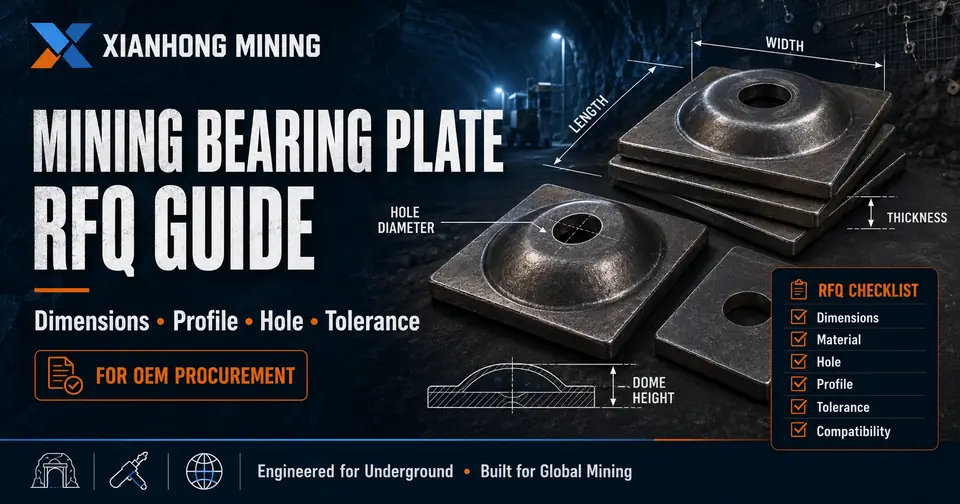
A bearing plate quotation depends on plate dimensions, material grade and thickness, hole diameter, dome profile, tolerance requirements, and compatibility with the bolt assembly. Without these fields, the manufacturer cannot assess tooling, stamping capability, or material sourcing. This guide lists the seven specification fields that a buyer must confirm when requesting a bearing plate quotation.
What Is a Mining Bearing Plate?
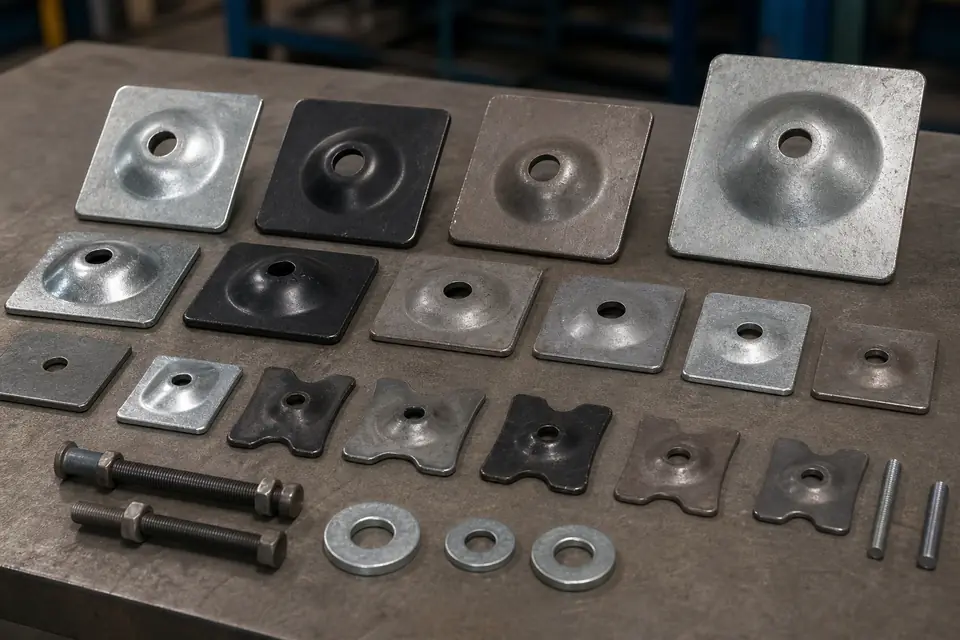
A mining bearing plate is a steel component installed between the rock bolt assembly and the supported surface to transfer and distribute applied loads from the bolt system. Bearing plates are typically stamped from steel plate and may be flat or domed in profile. The plate is manufactured according to approved drawings and supplied as part of a complete ground support assembly with rock bolts, nuts, and washers.
This article does not cover support design, load calculation, or site suitability. It focuses on what a buyer needs to specify for procurement of the plate.
Mining Bearing Plate RFQ Specification Checklist
| # | Field | Why It Matters | Risk If Missing | Buyer Should Confirm |
|---|---|---|---|---|
| 1 | Plate Dimensions | Determines material weight and tooling | Cannot quote material or stamping | Width, length, and thickness per drawing |
| 2 | Material Grade and Thickness | Affects sourcing, stamping tonnage, and cost | Wrong material or production failure | Grade, standard, and nominal thickness |
| 3 | Hole Diameter and Profile | Must match bolt shank and washer | Bolt cannot pass through or plate cannot seat | Hole diameter, shape, and counterbore |
| 4 | Dome Height / Profile Shape | Affects plate seating and load transfer | Incorrect profile, installation issues | Dome height, neck radius, and curvature |
| 5 | Tolerance Requirements | Defines acceptable variation | No basis for acceptance or rejection | Which dimensions need tolerances and which follow general |
| 6 | Surface Treatment | Affects corrosion resistance | Wrong finish, premature corrosion | Treatment type and dimensional impact |
| 7 | Bolt and Washer Compatibility | Ensures assembly fit | Incompatible components on site | Match between plate hole, bolt diameter, and washer |
1. Plate Dimensions
Plate dimensions include the overall width, length, and nominal thickness of the plate before forming. These are the first fields the manufacturer needs to assess material weight, tooling availability, and stamping capability.
Why it matters: Dimensions determine the raw material weight, the die size required, and the stamping press tonnage. A plate that is too large for the existing die may require new tooling. A plate that is too thick for the press may not be formable with current equipment.
Risk if missing: The manufacturer cannot calculate material usage or assess stamping feasibility. The quotation may be delayed or based on assumed dimensions that do not match the project.
What the buyer should confirm:
- Overall width and length as per the approved drawing
- Nominal thickness before forming
- Whether dimensions are fixed or allow options
2. Material Grade and Thickness
Material grade specifies the steel grade used to manufacture the plate. Common references may include Chinese steel grades such as Q235, Q345, Q355, or equivalent grades specified by the buyer according to applicable standards. Thickness is the steel plate thickness before stamping. After stamping, the effective thickness at formed areas may change due to material flow.
Why it matters: Material grade and thickness directly affect raw material sourcing, stamping tonnage, and cost. They also determine the mechanical properties of the finished plate. A plate stamped from 6 mm Q345 steel may have different forming behavior and mechanical properties from one stamped from 8 mm Q235 steel — the combination of grade and thickness must be confirmed before production.
Risk if missing: The manufacturer may quote using a default grade and thickness that do not meet the project specification. The buyer may receive a product with different mechanical properties than intended.
What the buyer should confirm:
- Material grade as specified in the approved drawing or order
- Nominal thickness before stamping
- Whether a material certificate is required
- Whether the grade reference includes the standard and edition
- Whether alternative grades are acceptable
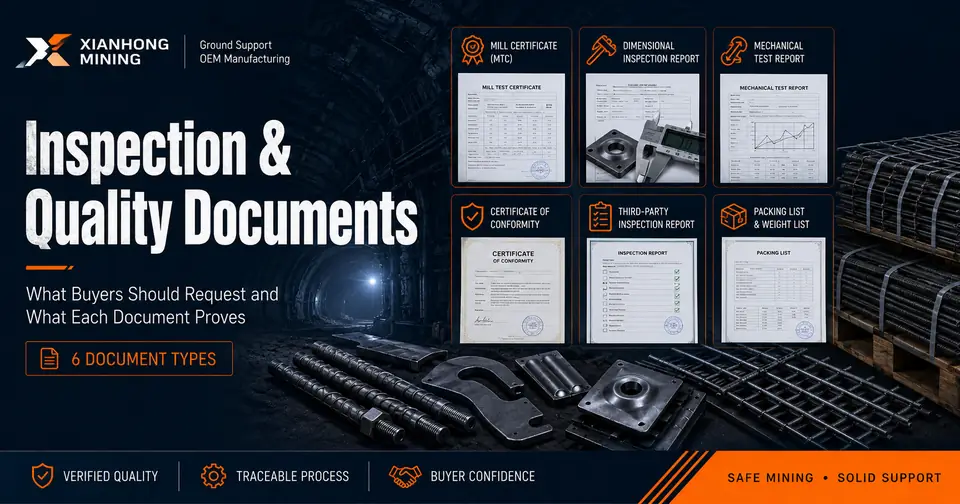
The material grade specifies the steel category. Actual chemical and mechanical data should be confirmed through a material certificate — see our article on inspection and quality documents.
3. Hole Diameter and Profile
Hole diameter is the size of the center hole in the plate through which the rock bolt passes. Hole profile includes the hole shape (circular, slotted, or other) and any counterbore, chamfer, or recess around the hole.
Why it matters: The hole must match the bolt shank diameter and any washer or spherical seat used. If the hole is too small, the bolt will not pass through. If the hole is too large, the plate may not seat properly under load. A counterbore or chamfer may be required to accommodate a spherical washer or nut.
Risk if missing: The manufacturer cannot determine which punch or piercing tool to use. The hole may be produced in the wrong size or shape, making the plate incompatible with the bolt assembly.
What the buyer should confirm:
- Hole diameter as per the approved drawing
- Hole shape (circular, slotted, or other)
- Whether a counterbore, chamfer, or recess is required
- Whether the hole is punched before or after forming
4. Dome Height / Profile Shape
Dome height is the vertical distance from the base of the plate to the top of the dome. Profile shape includes the curvature, neck radius, and overall form of the stamped section. Not all bearing plates are domed — some are flat plates with a hole only.
Why it matters: The dome profile affects how the plate seats against the rock surface and how load is transferred from the bolt to the plate. Different dome heights and curvatures are designed for different bolt assemblies and surface conditions. For example, a plate with a dome height of 8 mm may not seat properly against an uneven rock surface where a 15 mm dome height is required. An incorrect dome height may cause the plate to sit unevenly or prevent proper nut seating.
Risk if missing: The manufacturer may produce a flat plate when a domed profile is required, or stamp the wrong dome height. The buyer discovers the mismatch during installation.
What the buyer should confirm:
- Whether the plate is flat or domed
- If domed: dome height as per the approved drawing
- Neck radius and curvature dimensions
- Whether the profile is dimensioned on the drawing
- Whether the dome is formed during stamping or as a separate operation
5. Tolerance Requirements
Tolerance defines acceptable dimensional variation during manufacturing. Not every dimension requires the same tolerance level. This is the field where buyers most often leave information missing — and where the most disputes arise.
Why it matters: Different dimensions affect different functions. Critical dimensions that affect assembly, load transfer, or compatibility must have specified tolerances. Other non-critical dimensions may follow general manufacturing tolerances agreed between buyer and manufacturer.
Dimensions that typically require specified tolerances:
- Hole diameter — affects bolt compatibility and washer seating
- Dome height — affects plate seating and nut engagement
- Thickness — affects material performance and load capacity
Dimensions that may follow general manufacturing tolerances:
- Overall width and length (non-critical outer dimensions)
- Non-mating surface dimensions
- Cosmetic or non-functional features
Risk if missing: Without specified tolerances on critical dimensions, the buyer has no basis for rejecting plates that deviate from the nominal drawing. The manufacturer may apply general tolerances that do not meet the project requirement. Returning to the 8,000-piece inquiry: if the buyer has not specified tolerances on the drawing, which dimensions are critical? When the buyer has not provided tolerances, the manufacturer should submit proposed tolerance values for written buyer approval before production — not set them unilaterally.
Not every dimension requires the same tolerance level. Buyers should identify critical dimensions that affect assembly, load transfer, or compatibility. Other non-critical dimensions may follow general manufacturing tolerances agreed between buyer and manufacturer.
What the buyer should confirm:
- Which dimensions are critical and require specified tolerances
- Which dimensions can follow general manufacturing tolerances
- Whether tolerances are stated on the drawing or in a separate specification
- Whether the manufacturer's proposed tolerance values are accepted in writing
6. Surface Treatment
Surface treatment is the protective coating or finish applied to the plate to prevent corrosion during transport, storage, and service. Common options include black (untreated), oiled, painted, or galvanized.
Why it matters: Underground environments are humid and corrosive. The wrong surface treatment can lead to premature rust or rejection during inspection. Certain coating processes, such as hot-dip galvanizing, can add a layer that affects hole dimensions and profile geometry.
Risk if missing: The manufacturer may supply untreated plates by default. The buyer discovers the issue when the products arrive without the expected corrosion protection.
What the buyer should confirm:
- Surface treatment type as specified in the order
- Whether treatment affects hole or profile dimensions
- Whether treatment is applied before or after stamping
- Whether galvanizing thickness is specified
7. Bolt and Washer Compatibility
Bolt and washer compatibility confirms that the plate hole, bolt diameter, and washer dimensions are matched as a set. A bearing plate does not function alone — it is part of an assembly that includes the rock bolt, nut, and washer.
Why it matters: If the plate hole is sized for a 20 mm bolt but the project uses 22 mm bolts, the plate cannot be installed. If a spherical washer is used but the plate has no counterbore, the washer may not seat properly. Compatibility must be confirmed before production, not on site.
Risk if missing: The manufacturer produces plates based on the drawing alone, without checking whether the hole matches the bolt and washer specified elsewhere in the project. The buyer discovers the incompatibility during installation.
What the buyer should confirm:
- Bolt shank diameter that will pass through the plate hole
- Washer type (flat, spherical, or other) and whether a counterbore is needed
- Nut type and whether it seats properly on the dome profile
- Whether compatibility is confirmed across all components — see our resin rock bolt bar specifications for bolt diameter and thread requirements
How Xianhong Defines Bearing Plate Specifications
Xianhong evaluates bearing plate specifications through:
1. Customer Drawing Review
The manufacturer reviews the approved drawing to confirm plate dimensions, profile shape, hole diameter, dome height, and any counterbore or chamfer requirements. Missing information is compiled into an open item list.
2. Manufacturing Feasibility
The manufacturer assesses tooling availability — whether existing dies can produce the required plate size and profile. Stamping press capability is checked against material thickness and grade. Material sourcing is confirmed for the specified steel grade.
3. Inspection Requirements
The manufacturer confirms which dimensions require specified tolerances and which can follow general manufacturing tolerances. Inspection records and material certificates are linked to the order — see our article on inspection and quality documents.
4. Production and Export Preparation
After specification confirmation, the manufacturer releases the production order with the approved drawing, material requirements, and inspection plan. Export packing and documentation are prepared according to the order.
Typical achievable manufacturing capability, subject to material, tooling, geometry, and approved drawing. When a conflict exists between this article's general information and the approved drawing, the approved drawing governs.
Summary
A complete RFQ helps the manufacturer provide a faster and more accurate quotation. When the seven fields above are provided, the manufacturer can assess tooling, stamping capability, and material sourcing without back-and-forth confirmation. When fields are missing — especially tolerance requirements — the quotation is delayed or based on assumptions.
For a coordinated RFQ covering bearing plates together with W-straps and welded mesh, use the Mining Surface Support Procurement Guide to align buyer-approved component requirements, interface references, inspection evidence, identification and packing inputs.
**[
Download Mining Bearing Plate Drawing Checklist (PDF)
]**
A practical checklist helping buyers confirm dimensions, hole requirements, profile details, tolerance requirements, and compatibility information before requesting a quotation.
Related: Resin Rock Bolt Bar Specifications | Inspection and Quality Documents for Mining Ground Support Products | Bearing Plate Product Page