
PILLAR GUIDE · Mining Surface Support Procurement
Continue into the focused buying questions.
This page is the topic map. Use the focused guides below for product, interface, documentation and order-stage detail.
- Mining Ground Support Component Interfaces: A Buyer's Compatibility ChecklistA practical compatibility checklist for mining ground support components, explaining how buyers should confirm thread, diameter, hole spacing, profile, washer and mesh interface requirements before ordering.
- W-Strap Specification Guide for Mining Procurement: 7 Key RFQ Fields Buyers Must ConfirmA practical W-Strap procurement guide covering seven RFQ inputs: width, thickness, hole pattern, hole spacing, material grade, surface treatment, and length with tolerance.
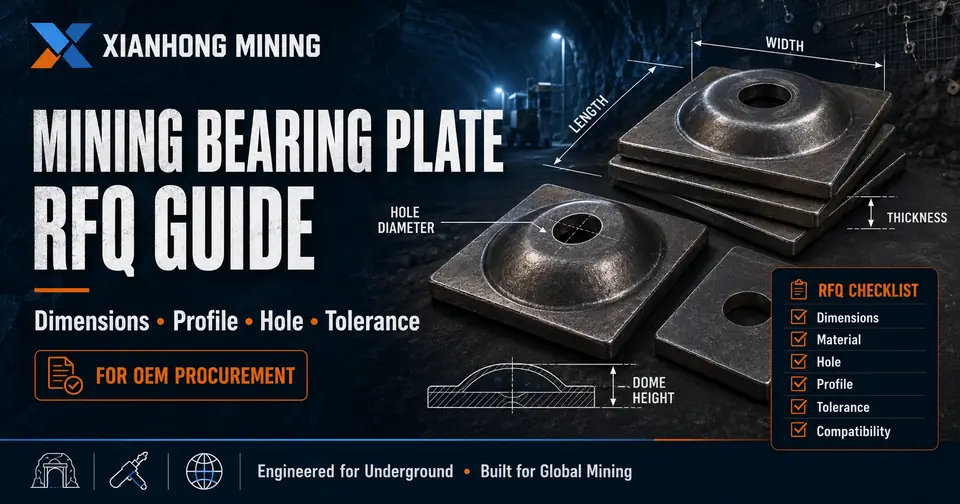
- Mining Bearing Plate RFQ Guide: Dimensions, Profile, Hole and Tolerance Requirements for OEM ProcurementLearn the key RFQ requirements for mining bearing plates, including dimensions, hole specifications, dome profile, tolerance requirements, material selection, and compatibility information for OEM procurement.
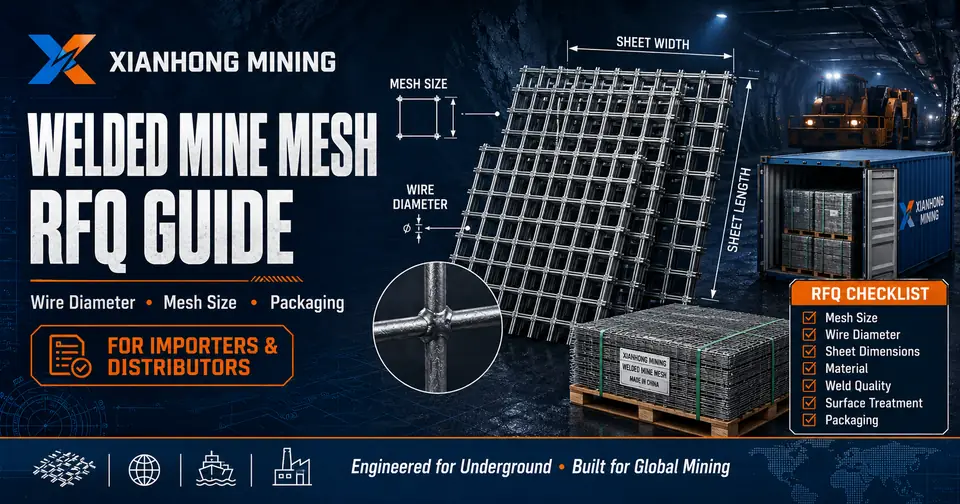
- Welded Mine Mesh Specification Guide: RFQ Requirements for Importers and DistributorsA practical RFQ guide for welded mine mesh covering the mesh opening or spacing convention, wire diameter, panel dimensions, material, weld, finish and packing requirements.
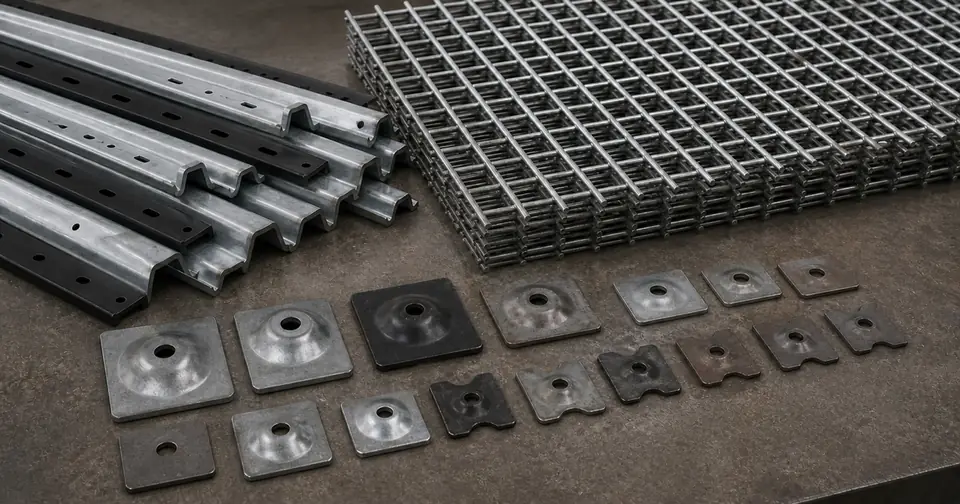
W-straps, welded mesh and bearing plates may be purchased as separate line items. When the buyer's approved project documents define relationships among those items, the RFQ should carry the relevant component and interface requirements into the purchasing package.
This guide explains how to organize those procurement inputs. It does not select a support system, define an installation arrangement or determine whether a component combination is suitable for a mine or ground condition. Those decisions remain with the buyer and the qualified project engineer.
Define the Procurement Scope
For this guide, a surface-support procurement package means a buyer-controlled group of W-straps, welded mesh and bearing plates. The actual components, their functions and their installed arrangement depend on the buyer-approved support design and project documents.
The three product groups covered here are:
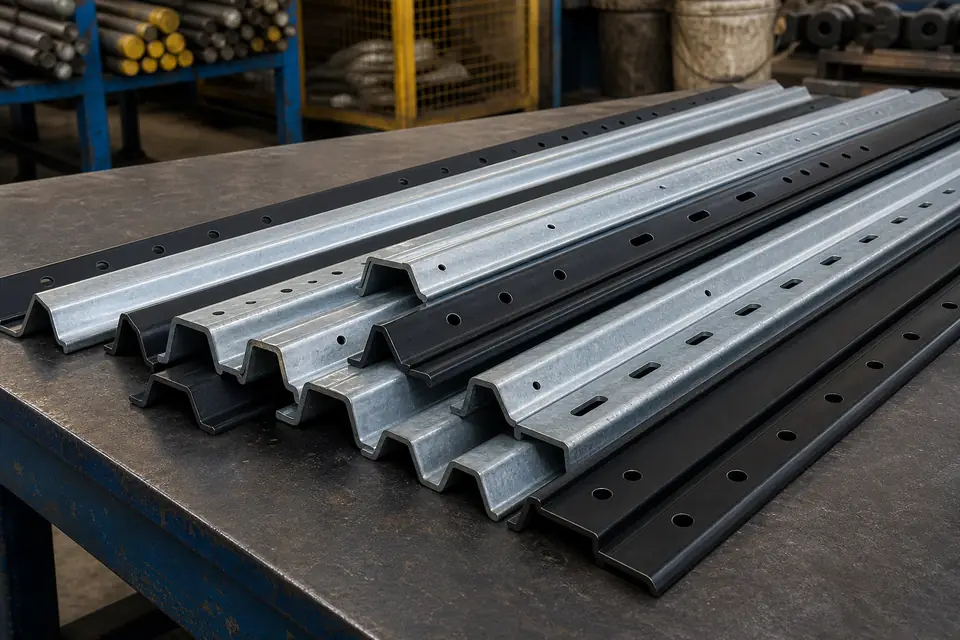
- W-straps — roll-formed steel profiles manufactured to the specified section, dimensions, holes, material, finish and tolerances.
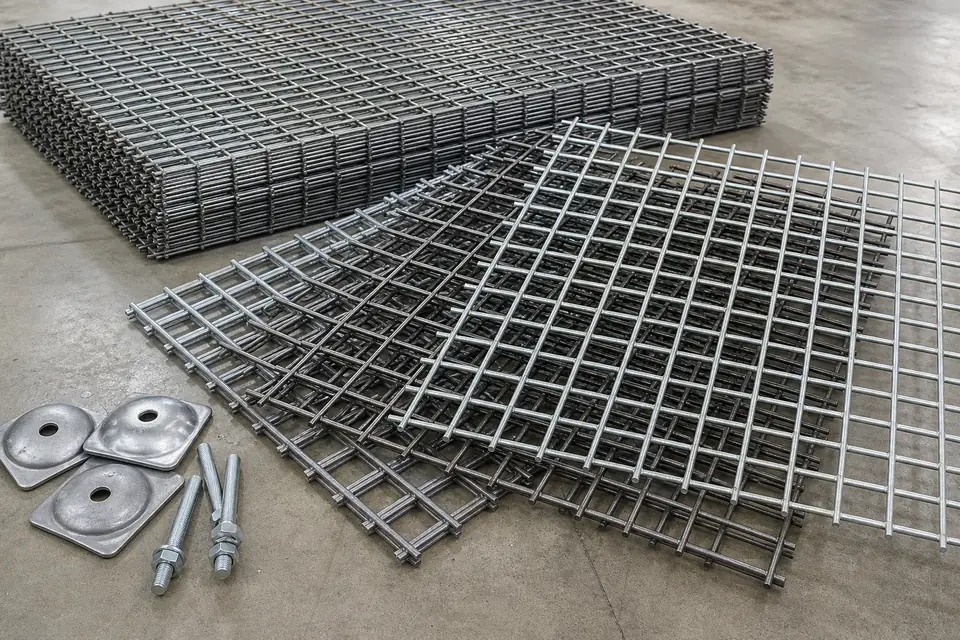
- Welded mesh — welded wire panels or rolls manufactured to the specified wire, grid, panel, edge, material, finish and fabrication requirements.
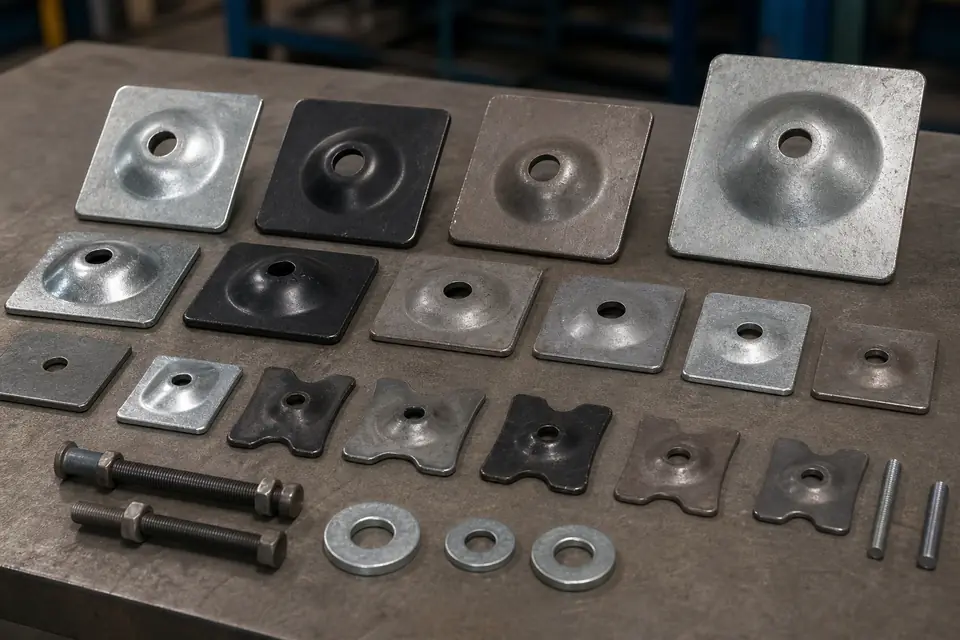
- Bearing plates — flat, domed or otherwise specified plates manufactured to the stated dimensions, profile, hole or seat geometry, material, finish and tolerances.
They can be quoted in one RFQ or in a controlled set of linked RFQs. The procurement-control requirement is the same: each line item must identify its own approved specification or drawing revision, and any buyer/engineer-approved relationship between components must be carried through a common package reference, configuration drawing, interface schedule or other controlled document.
Start with Buyer-Approved Requirements
Before requesting a quotation, the buyer should identify the documents that control each component and the package as a whole. Depending on the project, these may include:
- Component drawings and specifications — the requirements for each W-strap, mesh panel or roll, and bearing plate.
- A configuration or assembly reference — where the project uses one to define component positions or relationships.
- An interface schedule or matrix — the buyer/engineer-approved dimensional relationships that suppliers are expected to follow.
- Revision and effectivity records — the current approved revision for each component document and the order, package or configuration to which it applies.
- Inspection, identification and packing requirements — the acceptance evidence and delivery records required by the buyer.
Different component drawings do not need to share the same revision letter or number. What matters is that the RFQ identifies the current approved revision of each document and links those documents to the same controlled purchasing baseline.
The manufacturer can review the submitted information for completeness, manufacturability and apparent dimensional or revision conflicts. If information is missing or appears inconsistent, the manufacturer can request clarification. This review does not approve the support design or confirm engineering compatibility.
W-Strap Procurement Inputs
An RFQ for W-straps should define the manufacturing and acceptance inputs needed for quotation. These may include:
- Profile or section — the buyer-approved cross-section, including the drawing or sample reference used to define it.
- Width, thickness and length — including applicable tolerances.
- Hole arrangement — hole diameter or slot dimensions, quantity, datums, pitch or spacing, edge distance and positional tolerances where specified.
- Material requirement — grade, applicable standard identifier and edition or revision, and any required material-document scope.
- Surface condition or coating — the required finish or coating system, governing specification and edition or revision, and acceptance criteria.
- Performance and inspection requirement — any characteristics already specified by the buyer or qualified engineer, together with the required test or inspection method, applicable standard and edition or revision, sampling or frequency, acceptance criteria and records. Their inclusion in the RFQ does not imply that every supplier has the required process or test capability; the quotation must confirm the offered scope.
- Identification and packing — part, batch, bundle or package identification and the required packing method.
- Controlled references — the W-strap drawing revision and any buyer-approved interface or configuration reference relevant to the item.
For a detailed W-strap RFQ field list, see the W-Strap Specification Guide and the current Mining W-Straps product page.
Welded Mesh Procurement Inputs
The RFQ should reproduce the mesh terminology and measurement convention used in the buyer-approved drawing or specification rather than using “mesh size” without a defined basis. If the controlled document describes a value as clear aperture/opening or as wire pitch or centre-to-centre spacing, the RFQ should use that stated convention and include the associated wire diameter and tolerances. The manufacturer should not infer or convert between conventions without buyer clarification.
Inputs may include:
- Wire diameter — including tolerance where required.
- Grid dimensions — the values, terminology and measurement convention stated in the buyer-approved document. If more than one nominal value is provided, its relationship and tolerance basis must be defined or clarified by the buyer.
- Panel or roll format — panel width and length, roll width and length, and applicable dimensional tolerances.
- Edge and fabrication requirements — overhang, flush-cut edges, trimming or another buyer-requested detail, subject to product-specific manufacturability review and a supply scope confirmed in the quotation.
- Performance, weld and inspection requirements — any characteristics already specified by the buyer or qualified engineer, with the test or inspection method, applicable standard and edition or revision, sampling, acceptance criteria and required records. The quotation must confirm the offered process and test scope.
- Material requirement — wire grade, applicable standard identifier and edition or revision.
- Surface condition or coating — the buyer-defined supply condition or coating system, governing specification and edition or revision, and acceptance criteria, subject to a product-specific supply scope confirmed in the quotation.
- Identification and packing — bundle or roll identification, unit count or mass basis, protection and handling limits supplied by the buyer.
- Controlled references — the mesh drawing or specification revision and any buyer-approved coverage, overlap or support-pattern reference relevant to procurement.
Reference configurations displayed on a product page are not project recommendations. Final dimensions, material, fabrication, inspection and packing requirements must come from the buyer-approved order documents.
See the Welded Mine Mesh Specification Guide and the current Welded Mine Mesh product page.
Bearing Plate Procurement Inputs
A bearing-plate RFQ should separate overall geometry from the hole and seat details. Inputs may include:
- Profile — flat, domed or another buyer-specified form, including curvature, dome height, neck radius or other controlled dimensions where applicable.
- Plan dimensions and thickness — width, length, thickness and their tolerances.
- Through-hole geometry — circular, slotted or another specified opening, with size, datums and tolerances.
- Seat or recess geometry — counterbore, recess or other seating feature where required; this should not be treated as a hole-shape description.
- Material requirement — grade, applicable standard identifier and edition or revision, and required material records.
- Surface condition or coating — the specified finish or coating system, governing specification and edition or revision, and acceptance criteria.
- Performance and inspection requirement — any characteristics already specified by the buyer or qualified engineer, with the test or inspection method, applicable standard and edition or revision, sampling or frequency, acceptance criteria and required records. The quotation must confirm the offered process and test scope.
- Identification and packing — the identification level and package controls stated by the buyer.
- Controlled references — the bearing-plate drawing revision and any buyer/engineer-approved bolt, washer, nut, strap or configuration reference relevant to the item.
Overall plate dimensions or “footprint” should not be described as a verified bearing area unless the responsible engineer has defined that requirement. The manufacturer works to the approved geometry and acceptance requirements supplied for the order.
See the Bearing Plate RFQ Guide and the current Mining Bearing Plates product page.
Document Buyer-Approved Interfaces
The buyer and qualified project engineer are responsible for approving the support configuration and functional compatibility of the selected components. Where their approved documents define component relationships, the RFQ should make those inputs traceable and reviewable.
Depending on the approved arrangement, the purchasing package may need to record:
- Bolt layout and W-strap hole pattern — the approved bolt-position reference and the separate W-strap hole datums, spacing and positional tolerances.
- Bearing-plate hole and seat inputs — the approved bolt, washer, nut or seating geometry relevant to the plate drawing.
- Plate and strap geometry — any buyer-approved contact, overlap or seating details that must be reflected in the component drawings.
- Mesh coverage and panel details — approved coverage, overlap, panel-edge or support-pattern references where they form part of the purchasing requirement.
- Document revision and effectivity — the current revision of each component document and the common package, assembly or interface reference that links them.
These are not universal interface requirements. Include only the relationships present in the buyer-approved documents. The manufacturer may cross-check submitted dimensions and revision references for apparent conflicts and request clarification, but that check is not engineering design approval or confirmation of site suitability.
For the wider set of controlled component inputs, see Component Interfaces: A Buyer’s Compatibility Checklist.
Material, Surface Condition and Coating Requirements
Each component should have its own material and surface requirement. The requirements do not need to be identical across the package.
For each item, the RFQ should state as applicable:
- the material grade and governing specification identifier and edition or revision;
- the intended supply condition when the order uses terminology such as “black” or “untreated”, without assuming that the term has one universal meaning;
- the coating material and process;
- the governing coating specification and edition or revision;
- coating mass, thickness or other controlled property;
- surface-preparation requirements;
- dimensional allowance associated with the coating;
- inspection or test method, sampling and acceptance criteria;
- the required material or coating records.
The manufacturer should not select a grade, coating or acceptance standard on behalf of the buyer. Alternatives or deviations require written buyer review and approval before they become order requirements.
Inspection and Quality Documentation
Document names do not by themselves establish what was inspected or proven. The RFQ should define the issuer, scope, traceability fields, sampling basis, acceptance criteria and order linkage required for each record.
Common document categories include:
- Material or Mill Test Certificate (MTC) — a material record whose value depends on its issuer, reported results, heat or lot reference, specification scope and documented linkage to the material used for the finished production batch. The document title alone does not establish its inspection-document type or evidentiary scope.
- Supplier-issued Certificate or Declaration of Conformity (CoC) — the supplier's declaration against the contractually identified requirements. It is not independent test evidence and should not be treated as proof that every characteristic was tested. Any third-party certificate must be identified separately with its issuer and scope.
- Dimensional Inspection Report — a record of the characteristics actually measured, the results, the applicable drawing, specification or other controlled requirement reference and revision, instruments or method where required, sampling or inspection frequency, and acceptance criteria.
- Third-Party Inspection Report — a record limited to the inspection body's stated appointment, activities, observations, sampling and any conclusion made within its stated scope and acceptance criteria. The buyer should define the required body and scope.
Package-level coordination comes from document linkage, not from forcing unrelated component documents to use the same revision. The buyer should require records to identify the relevant component or item, drawing/specification revision, production batch or other traceability unit, purchase order and package reference as applicable.
For document scope and limitations, see Mining Ground Support Quality Documents.
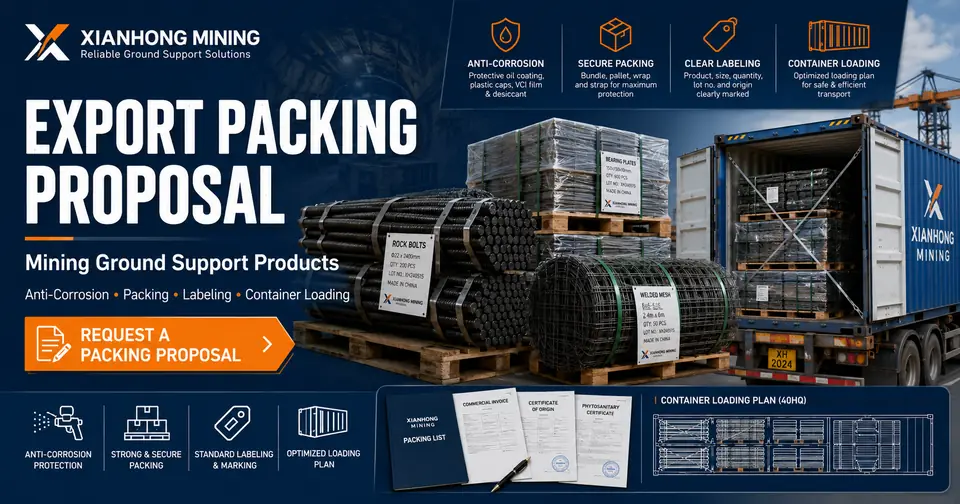
Identification and Export Packing
The buyer should define the required identification depth and the records that link products to the order. Identification may be applied to an individual part, tag, bundle, pallet, crate or another agreed level. Permanent marking on every component should not be assumed unless the buyer requires it and the approved process is suitable for the product.
A heat reference and a production-batch reference may represent different traceability units under the applicable order and quality controls. The RFQ should not treat them as interchangeable without the buyer-approved definitions. Where material-to-production-batch linkage is required, the RFQ should identify the records and traceability procedure that must preserve it.
Packing inputs may include:
- package type and protection method;
- unit count, bundle mass and handling limits;
- labels, shipping marks, controlled artwork revision, colour, size, position, application method, approved proof and any required buyer trademark authorization;
- package-to-packing-list references;
- destination handling and storage inputs supplied by the buyer;
- component, batch, order and package references required for receipt checking.
The buyer should provide confirmed destination-specific import, customs, certification and marking instructions and identify the responsible issuer or approving party for each requirement. Xianhong will not infer those requirements; they enter the supply scope only when they are confirmed in the quotation and order documents. Responsibility outside that confirmed supply scope remains with the buyer and the applicable importer, broker, authority or other responsible party.
See Product Identification and Marking and Export Packing, Labeling, Palletizing and Container Loading.
Build a Controlled Surface Support RFQ
A coordinated purchasing package can be issued as one RFQ or as several linked RFQs. The control objective is that suppliers receive the approved requirements and can identify how each line item relates to the same purchasing baseline where the buyer's documents require coordination.
The package should include:
- each component's part or item identifier, drawing/specification number and current approved revision;
- the common configuration, assembly, interface schedule or package reference, if applicable;
- documented buyer/qualified-engineer approval of functional interface requirements;
- quantities and units of measure;
- material, dimensions, tolerances, surface condition and coating requirements;
- inspection, sampling, acceptance and document requirements;
- identification, traceability and packing requirements;
- destination, requested delivery basis and named delivery point as defined by the buyer;
- a process for written clarification, deviation review and buyer approval.
The requested manufacturer review should be limited to input completeness, product-specific manufacturability and apparent dimensional or revision conflicts in the supplied documents. The quotation and clarification record must confirm the actual review, process, inspection and supply scope offered. The buyer and qualified project engineer retain responsibility for the support design, component selection, interface approval, installation method and site suitability.
After technical and documentary scope has been aligned, use the OEM Quotation Comparison Guide to compare supplier offers on a like-for-like basis.
Responsibility Boundary
Xianhong Mining is an OEM and contract manufacturer of mining ground-support components. Production is controlled against buyer-approved drawings, specifications, samples, target parameters, inspection requirements, marking and packing instructions.
For this article, any Xianhong review is limited to:
- review whether submitted requirements are sufficiently defined for quotation and manufacturing;
- review manufacturability against the supplied requirements;
- identify apparent dimensional, document or revision conflicts and request clarification;
- record approved clarifications and deviations for order control.
The quotation and final order documents must confirm the product-specific manufacturing, inspection, documentation and packing scope that Xianhong has agreed to supply. This article does not represent every requested process, test or product variant as an existing capability.
Xianhong does not approve:
- mine or ground-support system design;
- geological assessment, load selection or bolt layout;
- component combination or functional interface compatibility;
- installation design or method;
- installed performance, project outcomes or site suitability;
- destination-country import, customs, certification or legal compliance.
Those decisions remain with the buyer and the qualified engineer, importer, broker, authority, carrier, bank or other responsible party as applicable.
RFQ Preparation Checklist
- [ ] Identify each component drawing/specification and its current approved revision.
- [ ] Identify the common package, configuration or interface reference, if applicable.
- [ ] Record buyer/qualified-engineer approval of required component relationships.
- [ ] Define W-strap section, dimensions, holes, material, finish, tolerances and buyer/engineer-specified performance or test requirements, where applicable.
- [ ] Define mesh wire diameter, buyer-approved grid terminology and measurement convention, panel or roll dimensions, edges, material, finish and buyer/engineer-specified performance or test requirements, where applicable.
- [ ] Define bearing-plate profile, dimensions, through-hole, seat or recess, material, finish, tolerances and buyer/engineer-specified performance or test requirements, where applicable.
- [ ] Record every applicable material, coating, test and inspection standard identifier and edition or revision.
- [ ] Define material, coating and quality-document scope separately for each component.
- [ ] Define identification depth, heat/batch linkage where required, packing and package records.
- [ ] State quantities, units, destination, delivery basis and schedule.
- [ ] Record clarification and deviation approvals before order requirements are finalized.
Separate line items can be controlled as one purchasing package when they share the buyer-approved references required for coordination.
Prepare Your RFQ
Review the OEM manufacturing process and send the buyer-approved W-strap, welded mesh and bearing-plate requirements through the RFQ / Contact page. Request a product-specific manufacturability review; the quotation and clarification record will confirm the review and supply scope offered by Xianhong. This review does not replace support-system design or interface approval by the buyer and qualified project engineer.
Download the Procurement Guide
Download the Mining Surface Support Procurement Guide (PDF)
Sources and evidence basis
- Xianhong Mining W-Straps product informationinternal
- Xianhong Mining Welded Mine Mesh product informationinternal
- Xianhong Mining Bearing Plates product informationinternal
- Mining ground support component interfaces checklistinternal
- Mining ground support quality documents guideinternal
- Product identification and marking guideinternal
- Export packing and container loading guideinternal