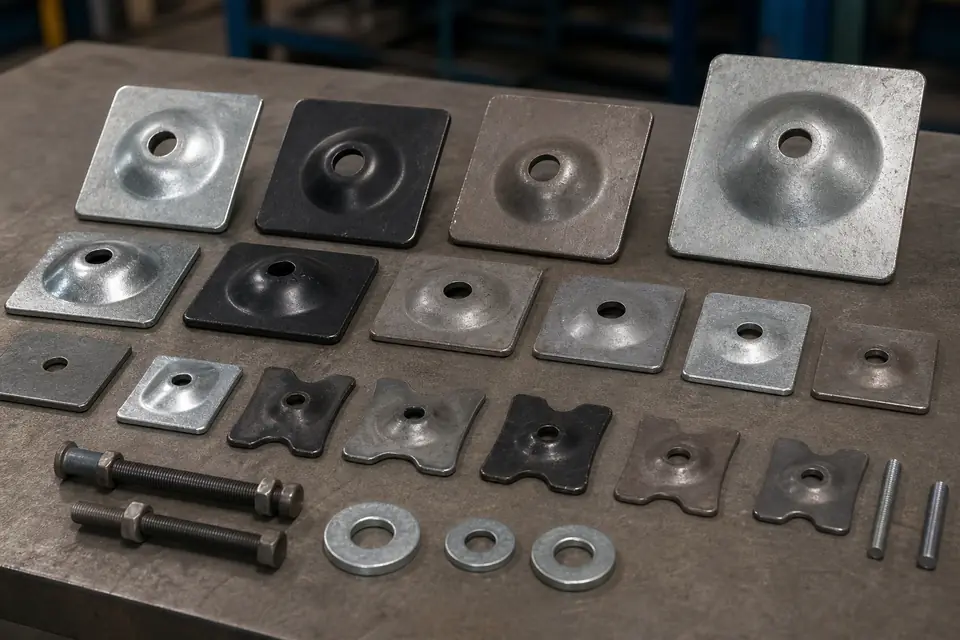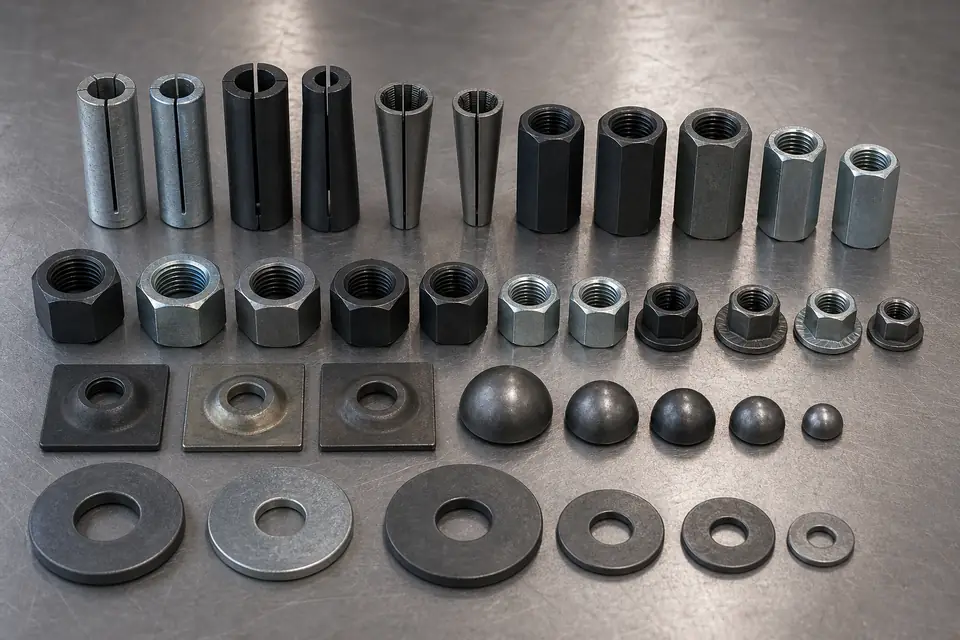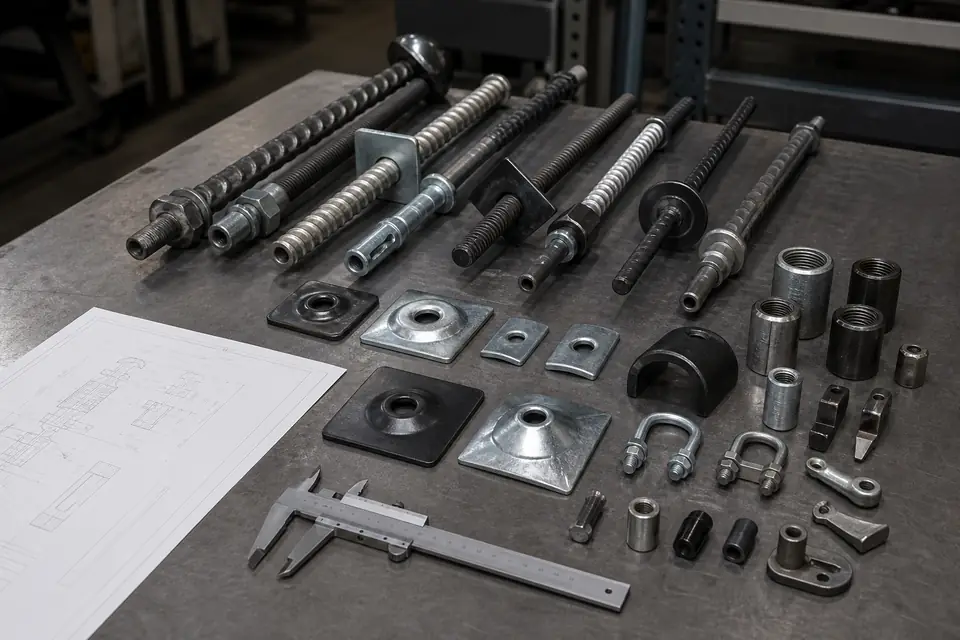

The bolt diameter is correct. The nut thread fits. But the washer does not seat correctly against the bearing plate.
A mining rock bolt washer may look like a simple steel component, but it forms part of the load path between the nut and the bearing plate. Its hole size, outside dimensions, thickness, seating profile, material condition, and coating must be compatible with the approved assembly. A washer that is too small may not bridge the plate opening. A washer with the wrong seating geometry may contact only part of the plate or nut face, creating an uneven bearing condition.
For this reason, rock bolt washers should be purchased as drawing-controlled or specification-controlled components, not as generic hardware selected only by nominal bolt diameter.
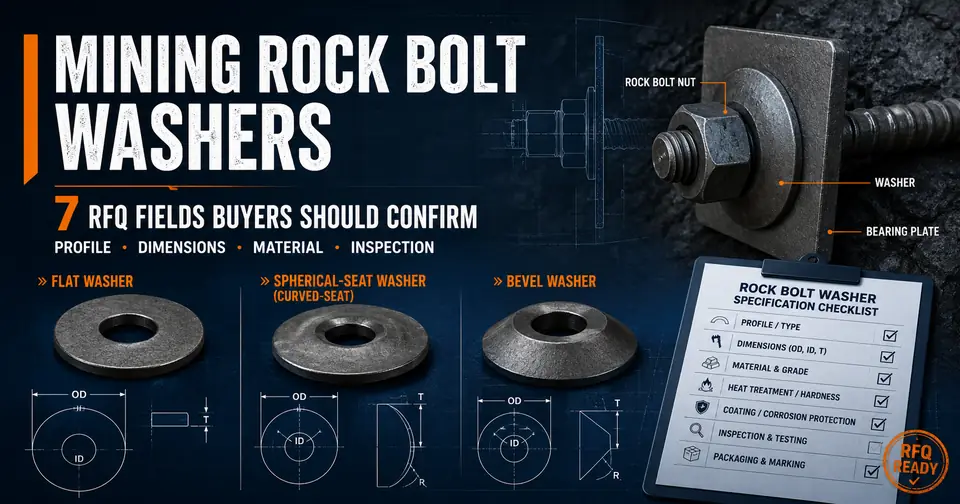
This guide explains the seven RFQ fields buyers should confirm before requesting a quotation for mining rock bolt washers.
Responsibility boundary: This article provides general product and procurement information. Final product selection, support design, installation parameters, and suitability for site conditions must be confirmed by the buyer, mine owner, qualified engineer, or approved technical authority. Xianhong manufactures to buyer-approved drawings and specifications and does not assume responsibility for mine support system design.
Mining Rock Bolt Washer RFQ Checklist
| # | RFQ Field | What the Buyer Should Define | Main Risk If Missing |
|---|---|---|---|
| 1 | Washer configuration and seating function | Flat, spherical-seat, bevel, or buyer-defined profile; contact-face orientation | Incorrect seating, angular misalignment, or concentrated contact |
| 2 | Mating components and interface references | Bolt or bar section, nut bearing face, plate hole, plate profile, and approved drawings | Washer does not pass over the bolt, bridge the opening, or seat with the nut and plate |
| 3 | Critical dimensions and tolerances | OD or width, ID or hole shape, thickness, profile radius or angle, flatness, and tolerances | No objective manufacturing or acceptance basis |
| 4 | Material, hardness, and mechanical requirements | Material specification, hardness requirement, heat treatment, and any agreed performance test | Permanent deformation, cracking, or an unverified load path |
| 5 | Surface finish and coating condition | Finish type, coating specification, coating thickness, and dimensions before or after coating | Corrosion, coating interference, or loss of assembly clearance |
| 6 | Inspection and acceptance requirements | Inspection items, sample size, test method, acceptance criteria, and document package | Disputes over conformity and insufficient evidence for release |
| 7 | Packing, identification, and traceability | Packing unit, quantity, labels, lot identification, and linkage to assembly records | Mixed sizes, incorrect site issue, or inability to trace a reported problem |
1. Washer Configuration and Seating Function
The washer configuration determines how the nut bears against the plate and whether the approved assembly includes a flat seat, a curved seat, or a fixed-angle compensation surface.
Common configurations include:
- Flat washer or plain washer: A washer with flat bearing faces. It is used where the approved nut-to-washer and washer-to-plate seating surfaces are intended to be flat.
- Spherical-seat washer or curved-seat washer: A washer with a convex or concave seating surface intended to mate with a corresponding curved seat. It may provide angular adjustment within the limits of the approved assembly.
- Bevel washer or tapered washer: A washer with a defined angled face. It is generally used where a specified fixed angular offset must be accommodated.
- Buyer-defined formed washer: A stamped, forged, machined, or otherwise formed washer manufactured to an approved drawing or sample.
Terminology varies between markets and suppliers. Terms such as spherical washer, domed washer, hemispherical washer, and ball seat are not always used consistently. The RFQ should therefore define the geometry through a drawing, sectional view, sample, or unambiguous dimensional specification.
For a curved-seat washer, the buyer should not specify only “spherical.” The RFQ should identify:
- Which face is convex and which face is concave
- Which face contacts the nut
- Which face contacts the bearing plate
- The mating seat geometry or radius
- The permitted angular movement, if this is a controlled requirement
Why it matters: A curved washer does not automatically fit every domed bearing plate. The mating surfaces must be geometrically compatible. A formed plate dome may not be the same as a machined spherical seat.
Buyer confirmation points:
- Washer configuration and section profile
- Contact-face orientation
- Mating seat geometry
- Drawing number and revision
- Whether the washer is a standalone part or one element of a matched seating set
See the Mining Bearing Plate RFQ Guide for plate profile, hole, and tolerance inputs.
2. Mating Components and Interface References
A washer should be reviewed against all components it interfaces with, not only against the nominal bolt size.
The relevant interfaces normally include:
- Bolt or bar to washer: The maximum threaded, ribbed, upset, or plain section that must pass through the washer opening
- Nut to washer: The nut bearing-face diameter, seating form, chamfer, collar, or spherical feature
- Washer to bearing plate: The plate hole diameter or shape, counterbore or seat, and local plate profile
- Complete assembly: The stack height, available thread engagement, tightening access, and required installation orientation
Why it matters: A washer may have an ID that clears the nominal bar diameter but does not clear an upset section, rolled thread crest, coating buildup, or bar deformation tolerance. Similarly, an outside diameter may be larger than the plate hole but still provide insufficient bearing margin for the approved design.
The manufacturer should not be expected to determine the required interface from nominal product names alone. The buyer should provide the mating component drawings or the critical interface dimensions.
Buyer confirmation points:
- Bolt or bar drawing number and revision
- Maximum section that must pass through the washer opening
- Nut bearing-face geometry and dimensions
- Bearing plate hole diameter, shape, and local seating profile
- Required clearances after coating
- Whether mating parts are supplied by Xianhong or by another supplier
- Whether physical samples are required for interface verification
For a broader interface review, see Mining Ground Support Component Interfaces: A Buyer's Compatibility Checklist.
3. Critical Dimensions and Tolerances
Nominal bolt size is not a complete washer specification. The RFQ should define the dimensions that control fit, seating, manufacturability, and inspection.
Depending on the washer configuration, critical dimensions may include:
- Outside diameter (OD) for round washers
- Outside width and length for square, rectangular, or non-round washers
- Inside diameter (ID) or center-hole dimensions
- Hole shape, including round, square, slotted, or buyer-defined openings
- Thickness
- Overall formed height
- Spherical or curved-seat radius
- Bevel angle and orientation
- Counterbore, recess, collar, or chamfer dimensions
- Flatness, concentricity, or profile tolerance, where functionally required
- Edge and burr limits, where these affect assembly or safe handling
The dimensions should be accompanied by tolerances. A nominal value without a tolerance does not provide a complete acceptance criterion.
The buyer should also state whether dimensions are controlled in the as-formed, heat-treated, machined, or coated condition. This is particularly important when a coating changes the washer opening or seating profile.
Buyer confirmation points:
- Complete dimensional drawing or specification table
- Critical and non-critical dimensions
- Individual tolerances or referenced general tolerance standard
- Dimensional condition: before or after heat treatment and coating
- Required datum or measurement method for curved and angled profiles
- Approved sample status, where a sample controls geometry
Procurement note: Washer thickness and outside dimensions alone do not establish load capacity. Any required mechanical performance or assembly test must be stated separately.
4. Material, Hardness, and Mechanical Requirements
Material and hardness influence local bearing resistance, permanent deformation, crack resistance, manufacturability, and coating suitability. These requirements should be selected for the approved washer design and assembly rather than copied from an unrelated standard part.
For standardized plain washers, standards such as ISO 7089 and ISO 7090 define specific product grades, dimensions, and hardness classes. ISO 7089:2000 and ISO 7090:2000 include 200 HV and 300 HV washer classes. These classes should not be applied automatically to a custom mining washer unless the order explicitly invokes the relevant standard and the washer geometry falls within its scope.
For drawing-controlled spherical, bevel, or formed washers, the buyer should define:
- Material grade and applicable standard
- Standard edition, if contractually relevant
- Delivery condition or heat-treatment condition
- Hardness class or acceptable hardness range
- Test method and sampling requirement
- Any required proof, compression, deformation, or assembly test
The bearing plate should not be assumed to be a hardened component. Depending on the approved design, a plate may be manufactured from formed structural or carbon steel in a specified delivery condition. Compatibility therefore needs to be assessed from the actual approved material and geometry of the washer, nut, and plate.
Buyer confirmation points:
- Material grade and standard
- Heat-treatment or delivery condition
- Hardness requirement and test method
- Whether a material certificate is required
- Required lot or heat traceability
- Any product-level mechanical or assembly test
- Acceptance criteria and sample quantity
5. Surface Finish and Coating Condition
The RFQ should distinguish between the finish appearance, the coating process, and the required corrosion-performance basis.
Possible supply conditions include:
- Plain or as-manufactured
- Oiled or otherwise temporarily protected
- Zinc electroplated with a specified passivation or sealer
- Hot-dip galvanized
- Coated using another buyer-approved system
- Manufactured from pre-coated material, where technically acceptable
The word black is not a complete coating specification. It may refer to an as-formed surface, black oxide, phosphate and oil, paint, or another dark finish. The buyer should identify the actual process or the required performance.
ISO 4042:2022 specifies requirements for electroplated coating systems on steel fasteners, including dimensional considerations. ISO 10684:2004 covers hot-dip galvanized coatings for fasteners and states that its provisions may also be applied to non-threaded steel parts such as washers. The applicable standard, edition, coating designation, and any project-specific requirement should be stated in the order.
Coating can affect:
- Washer ID or opening clearance
- Curved-seat fit
- Counterbore or recess dimensions
- Surface friction
- Nut seating
- Visual acceptance
Where high hardness or high tensile strength makes hydrogen-embrittlement risk relevant, the coating specification should include the required prevention and verification controls.
Buyer confirmation points:
- Finish or coating process
- Applicable coating standard and designation
- Minimum, maximum, or local coating thickness, where required
- Passivation, sealer, oil, or topcoat requirement
- Whether dimensions apply before or after coating
- Required post-coating fit check
- Whether finished washers are coated after forming or made from pre-coated material
- Corrosion test requirement and acceptance criteria, if contractually required
6. Inspection and Acceptance Requirements
Inspection requirements should define what is checked, how it is checked, how many pieces are checked, and what constitutes acceptance.
Typical inspection items may include:
- Outside dimensions and washer opening
- Thickness and overall formed height
- Curved-seat radius, bevel angle, or profile
- Flatness or concentricity, where specified
- Material verification and certificate review
- Hardness
- Coating thickness or finish condition
- Visual condition, including cracks, laminations, burrs, sharp edges, and forming damage
- Assembly or interface verification with agreed mating components
- Packing quantity and label accuracy
A report that states only “Pass” without nominal values, tolerances, measured results, sample size, and drawing revision provides limited evidence. The buyer should specify whether actual measured values are required.
The inspection plan should also identify whether inspection is:
- 100% inspection
- Sampling inspection
- First-article inspection
- Pre-shipment inspection
- Buyer or third-party witness inspection
Buyer confirmation points:
- Inspection characteristics
- Drawing and revision used for inspection
- Sample size and sampling method
- Measuring or test method
- Acceptance criteria
- Required actual values and report format
- Material certificate, dimensional report, hardness report, coating report, certificate of conformity, or third-party report
- Hold, witness, or release points, where applicable
For document scope and evidentiary limits, see Inspection and Quality Documents for Mining Ground Support Products.
7. Packing, Identification, and Traceability
Packing must prevent size mixing, coating damage, corrosion exposure, and incorrect issue to the installation site.
The required level of traceability should be agreed in the purchase order. It may range from basic package identification to lot-level linkage with material and inspection records.
For washers supplied as part of a bolt, nut, and plate package, the buyer should define whether the components are:
- Packed separately by part number
- Packed in counted assembly kits
- Bundled or boxed by installation set
- Verified as a matched assembly before packing
Lot identification may include:
- Purchase order number
- Product description and part number
- Drawing number and revision
- Washer size and configuration
- Quantity per package
- Production lot or batch number
- Material heat or source-lot reference, where agreed
- Coating lot, where required
- Gross and net weight
- Destination, project, or shipping mark
Why it matters: If visually similar washers are mixed, the error may not be discovered until installation. Without a defined lot reference, a field issue cannot be efficiently linked to the relevant material, production, coating, inspection, and packing records.
Buyer confirmation points:
- Packing method and quantity per package
- Corrosion and moisture protection
- Part separation and anti-mixing controls
- Label content and shipping marks
- Required lot or heat traceability
- Whether washer lots must be linked to mating-component lots
- Whether a packing list or package-level count record is required
How Xianhong Reviews Rock Bolt Washer RFQs
For a drawing-controlled washer inquiry, Xianhong's review normally focuses on four areas:
-
Specification completeness
We review the washer configuration, drawing revision, material, dimensions, tolerances, coating, inspection, and packing requirements and identify open items before production release. -
Manufacturability and tooling
We assess whether the required geometry can be produced using the proposed stamping, forming, forging, machining, heat-treatment, and coating route, subject to the actual product design and available tooling. -
Component interface review
When the bolt, nut, bearing plate, or approved mating samples are included in the order scope, we cross-check the stated interface dimensions and identify inconsistencies for buyer confirmation. -
Inspection and lot-control planning
We agree the inspection characteristics, sampling scope, document package, packing method, and required traceability before shipment release.
Product availability and manufacturing route remain subject to material, tooling, geometry, quantity, inspection scope, and the buyer-approved drawing. If this article conflicts with the approved order documents, the approved order documents govern.
Summary
Mining rock bolt washers should be specified as controlled assembly components, not purchased only by nominal bolt size. Before requesting a quotation, the buyer should confirm:
- Washer configuration and seating function
- Mating components and interface references
- Critical dimensions and tolerances
- Material, hardness, and mechanical requirements
- Surface finish and coating condition
- Inspection and acceptance requirements
- Packing, identification, and traceability
A complete RFQ gives the manufacturer a clear basis for manufacturability review, quotation, production control, inspection, and shipment release. It also reduces the risk of discovering a seating or assembly mismatch after the products arrive on site.
Download the Mining Rock Bolt Washer RFQ Specification Sheet (PDF)
The downloadable sheet should capture washer configuration, mating-component references, dimensions, tolerances, material, hardness, coating, inspection, documentation, packing, and traceability requirements.
Buyer-approved drawings, specifications, samples, inspection plans, and purchase-order requirements govern the final supplied product.
Related: Resin Rock Bolt Bar Specifications | Mining Rock Bolt Nut RFQ Guide | Mining Bearing Plate RFQ Guide | Mining Ground Support Component Interfaces | Inspection and Quality Documents